Ownership Transition - Key Seller Risks

Whether you are buying a construction business or selling one, it is important to understand the perspectives of the other party, including what their major risks are.

D. Brown Management Profile Picture
Share

In general, each party will tend to discount the risks and concerns of the other and that impacts the ability to create the best deal.  
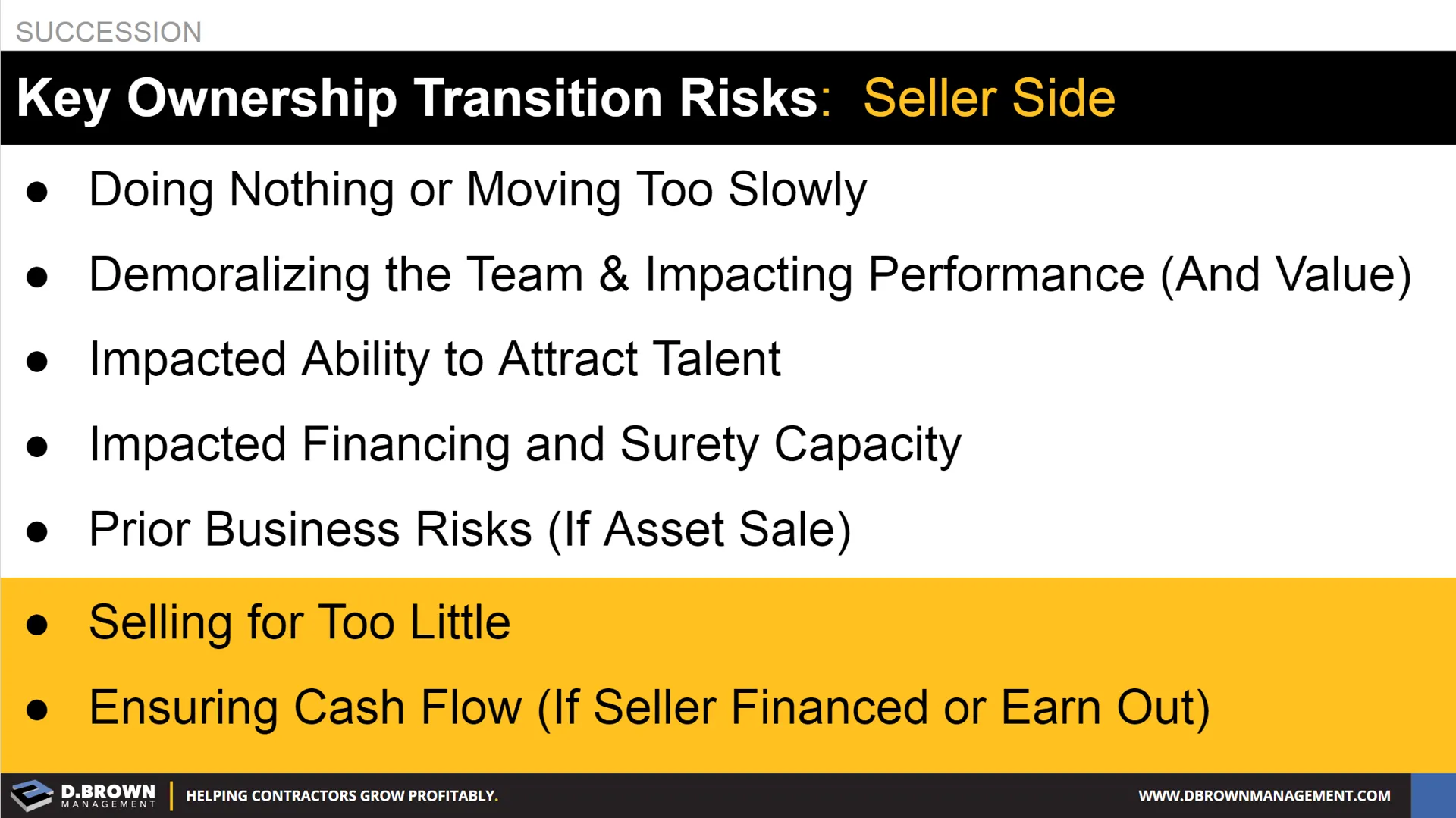
Succession: Key Ownership Transition Risks the Sellers Side.

The biggest seller risks are:

  • Doing nothing or moving too slowly is the biggest danger given today’s changing construction industry and shortage of executive level talent
  • If not done with the right levels of timing, education, and communication, the process is likely to demoralize the team and impact performance, and therefore, value.  
  • Following any internal demoralization, the ability to attract great talent will become impacted.  
  • Banks and sureties will start to look at their risks very differently if the business does not have a clear succession plan, especially as the owner(s) get into their late 50’s.  
  • If it is an asset sale, the current owner(s) must be able to roughly quantify the existing risks and how to mitigate them. 
  • Valuing and selling the business for too little, therefore not capturing the value they have created during their period of ownership. 
  • Since most sellers will be financing or earning out a portion of the sell price, they have significant risk around whether the business will be able to continue to generate the cash flow required.  

Ownership Transition - Key Seller Risks
Continue building value in your business, yourself and your key team members with a good succession strategy....

Ownership Transition - Key Seller Risks
Continue building value in your business, yourself and your key team members with a good succession strategy....

Degree of Discretionary Time with Growth in Role Levels and Business Size
The degree of discretionary time that someone has in doing their job grows with their role level - for example from crafts person to VP of Operations. For similar roles, that time decreases with company growth as the job roles become more tightly defined.
Opportunity Evaluation (2 Critical Dimensions)
Your strategic decisions show up most vividly in the opportunities you choose to pursue. Disciplined and aggressive business development will ensure a strong pipeline of opportunities. Choosing what to pursue requires balancing two critical dimensions.
The Journey (Length, Complexity, Ambiguity, and Guardrails)
Nearly everyone can get in their vehicle and drive to a destination at the end of a two-lane road. No single person can look at open land, select a place to build a city, build that city, build the infrastructure including roads, and build the vehicles.