Planning is Useless

Planning how to build a project and planning how to build a contracting business are VERY different and must be approached with a different mindset.

D. Brown Management Profile Picture
Share

When planning ‘how’ to build a project the ‘what’ is mostly known.  The means, methods, materials and tools used to build a project are pretty well known by the project team.  Planning a project is mostly about sequencing activities and dealing with a relatively small amount of unknowns.  
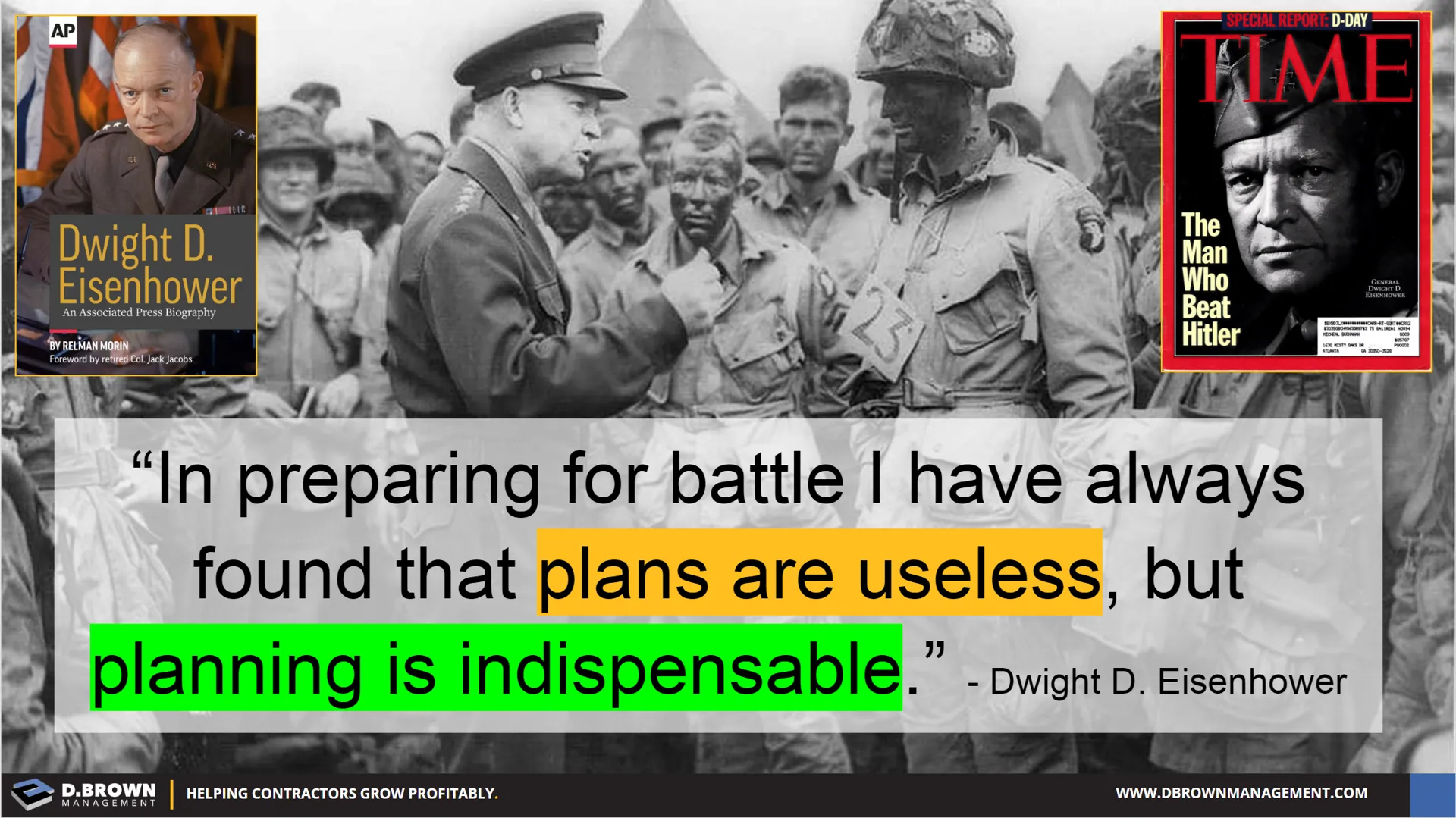
Quote: In preparing for battle I have always found that plans are useless, but planning is indispensable. Dwight D. Eisenhower.

Planning a contracting business is incredibly different starting with the fact that it is an ongoing process that is never “done” which is something that projects all eventually get to.  

On top of that a construction business has exponentially more variables than a construction project.  

What really effective teams do is look at planning much like a “workout”.  The energy used in the workout itself isn’t meant to accomplish anything. It is only meant to improve strength, cardio, flexibility, speed and coordination.  

That is the true value of business planning.  The plan itself will likely get off course as soon as the ink is dry.  It is how agile the team is in making the required course corrections that matters.  Without the training of the planning exercises teams are often reacting and this impacts performance.  

“Execution is a systematic process of rigorously discussing hows and whats, tenaciously following through, and ensuring accountability.”

Lawrence Bossidy: Retired CEO of Honeywell and author of Execution


Project Cash Metric and Cash vs. Margin Variance
Contracting is a very capital-intensive business and it is critical to constantly be watching cash flow performance. This metric is the highest level of an “OUTCOME” for cash flow at the project level, summarizing the performance of ops and accounting.
TOOL: Effective Scoreboards & Scorecards Outline
One-page summary that can be used with your team to align them around the why, what, and how of effective scoreboards and scorecards. Next steps include worksheets to inventory and evaluate your current state of scorekeeping and designing the future.
Private Equity and Construction
All of the trends that are changing the construction industry today require economies of scale and capital to truly take advantage of. Private Equity firms are seeing that trend and taking a bigger interest in the construction market.