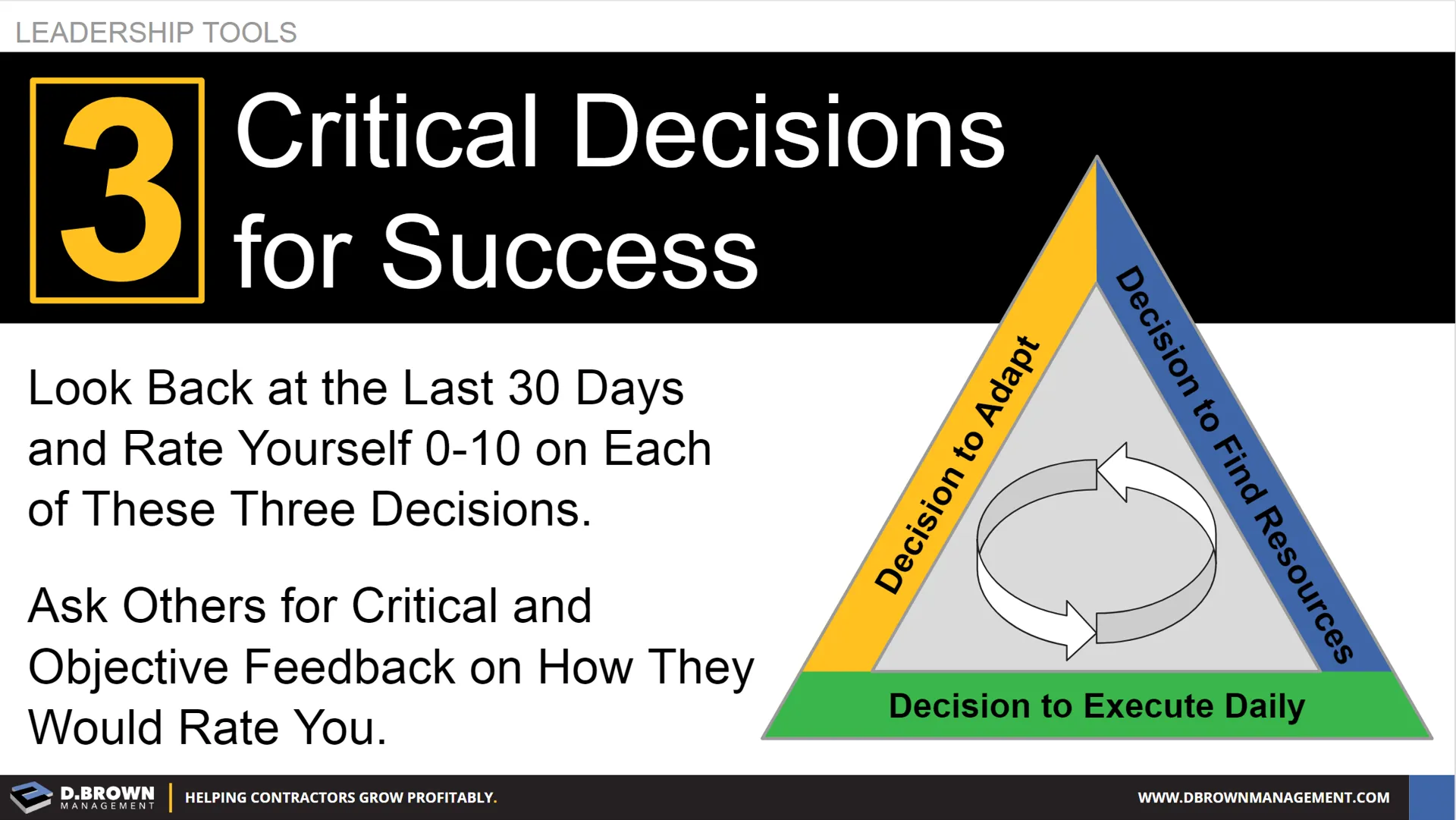
3 Critical Decisions for Success

As you look forward toward the new year, objectively evaluate yourself on the three critical decisions we all must make on a regular basis

D. Brown Management Profile Picture
Share

Full Article at LinkedIn

Leadership Tools: 3 Critical Decisions for Success. Decision to Adapt, Decision to Find Resources, and Decision to Execute Daily.

1.The Decision to Adapt:  

Do you have a clear vision of the skills and behaviors you need to demonstrate to be successful in the role you want (or need) to have five years from now?  

Have you truly made the decision in your mind that you need to build yourself? 

Hint - Writing this down in very specific and quantifiable language with timelines can be huge.


2.The Decision to Find Resources

Have you tenaciously sought out the resources that can help you build yourself? These resources include meeting the right people, joining the right groups, finding the right training, books, websites, etc.  

Hint - think about your first “low-bar” as having 50 conversations with people who are successful and closely associated with the role you want to build yourself into. 


3.The Decision to Execute DAILY

Have you laid out and stuck with a rigorous professional development program? 

Hint - this is as regular and committed as a routine you would use to train for a triathlon. Most successful people just simply train harder, train longer and are willing to fail more while continuing forward with a positive attitude.  


Ownership Transition and Capital Basic Model
When a contractor goes through an ownership transition, the business itself is the proverbial goose laying the golden egg. Remember the basic math formula for ownership transitions and use this simple calculator as a starting point.
Contractor Business Model: Evolution with Stages of Growth
As a contractor navigates the different stages of growth, the complexity of their business model evolves, including their organizational structure, management systems, and people. Seeing this model visually helps identify bottlenecks and constraints.
Lean Principle - Stop Work (Until Problems Are Corrected)
All construction projects will run into some degree of problems. It is how the project team chooses to manage these problems that ultimately determines the outcome of the project.