Insights from D. Brown Management
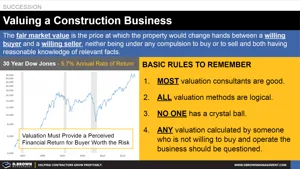
Valuing a Construction Business
 D. Brown Management
December 11, 2018
D. Brown Management
December 11, 2018
There is no single right way to value a construction business, although there are many methods that have validity. Keep in mind that the definition of “Fair Market Value” is quite simply what a willing seller and buyer agree to.
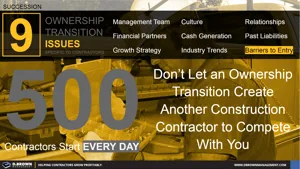
Issue 9 of 9: Low Barriers to Entry
D. Brown Management
December 10, 2018
Construction Ownership Transition Issue 9 of 9: There are Few Barriers to Entry for New Contractors. About 500 construction contractors start up each day. In most cases, a new contractor starting up will cause a serious talent drain and add competition.
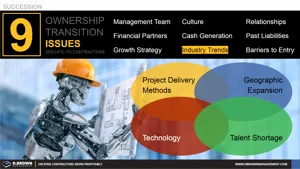
Issue 8 of 9: Industry Trends
D. Brown Management
December 9, 2018
Construction Ownership Transition Issue 8 of 9: The Construction Industry is Seeing Large Shifts With Several Interrelated Trends. How well the company is positioned will have a huge impact on valuation and cash generation.
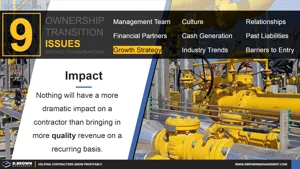
Issue 7 of 9: Growth Strategy
D. Brown Management
December 8, 2018
Construction Ownership Transition Issue 7 of 9: In general, with all other key factors including cash flow, profitability, and customer satisfaction being equal, a contractor that is growing will be able to better handle an ownership transition.
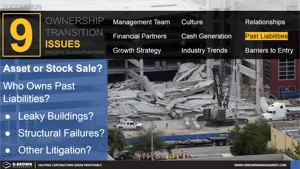
Issue 6 of 9: Past Liabilities
D. Brown Management
December 7, 2018
Construction Ownership Transition Issue 6 of 9: Who Will Own Past Liabilities - Asset or Stock Sale? Not only is construction a cash-intensive business, it is also a risky one.

Issue 5 of 9: Cash Generation
D. Brown Management
December 6, 2018
Construction Ownership Transition Issue 5 of 9: Does the Business Generate Enough Free Cash Flow to Make the Transition Equitable for All Parties? Review examples and play "what-if" based on your business.

Issue 4 of 9: Financial Partners
D. Brown Management
December 5, 2018
Construction Ownership Transition Issue 4 of 9: Are Your Financial Partners, including Bank and Surety, Onboard with the Transition?
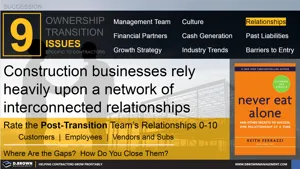
Issue 3 of 9: Relationships
D. Brown Management
December 4, 2018
Construction Ownership Transition Issue 3 of 9: How Strong are the Post-Transition Relationships with Customers, Employees, Vendors, and Subcontractors?
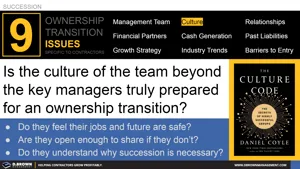
Issue 2 of 9: Culture
D. Brown Management
December 3, 2018
Construction Ownership Transition Issue 2 of 9: Is the Culture Truly Ready for Succession? Why does it matter to the employees what happens with succession? How does that impact value?
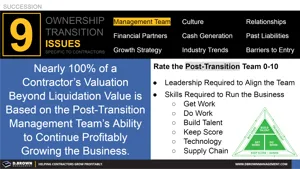
Issue 1 of 9: Strength of the Management Team
D. Brown Management
December 2, 2018
Construction Ownership Transition Issue 1 of 9: Strength and Alignment of the Management Team. Beyond liquidation, nearly 100% of the value of a construction business is based on the management team's ability to profitably grow the business.
