Changing a Good Decision Making Process Based on Results

Construction projects are complex requiring thousands of decisions made across dozens of teams over many months to ultimately result in a good outcome

D. Brown Management Profile Picture
Share
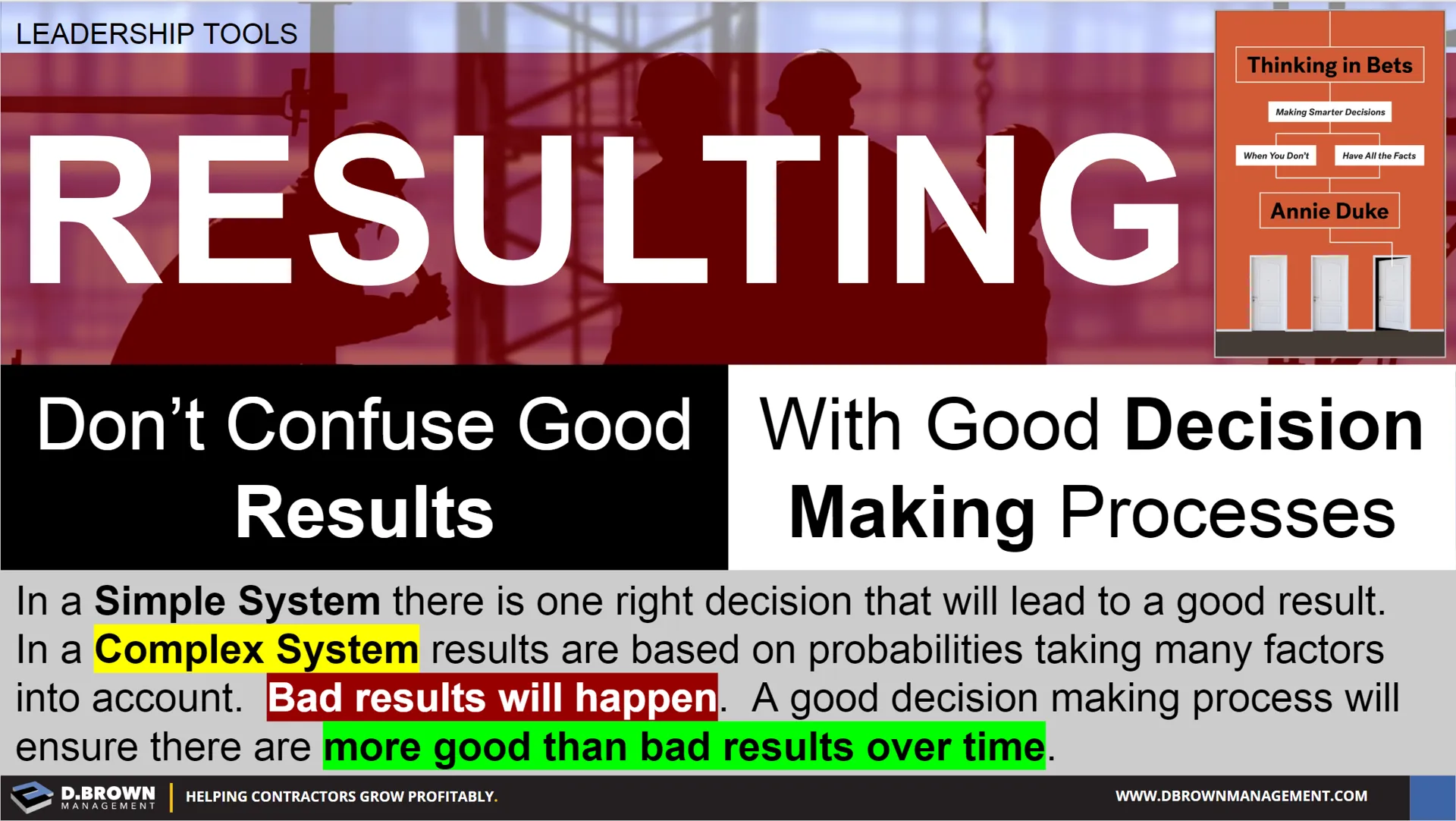
Leadership Tools: Resulting. Don't Confuse Good Results with Good Decision Making Processes. Book: Thinking in Bets by Annie Duke.

As a leader in the construction industry the majority of your value-add is:

  1. Making good decisions
  2. Ensuring those decisions are executed
  3. Teaching others how to do the same  

In a simple system the decision tree may have a few known variables and a single clear path which is easily trainable.  

Most project decisions are more complex having more variables and outside influences impacting results over a longer time span.  Given time pressures and limits of the human brain only a few of those variables can be accounted for accurately in our mental model of a situation.  

The results of a good decision making process are not 100% good but the average results over time are good.  Resulting is a term used in poker when a player starts changing a good decision making process based on the resulting outcomes.  This seems logical but will lead to an overall decline in results with increased variability.   

Smarter, Faster, Better


Contact us to learn how we train teams to make better decisions


Building Ships and Vision
There is a lot of work in building projects and building a construction company. It is easy to get mired down in endless to-do lists, processes and problems. The one thing that holds this all together accelerating performance is the company’s vision.
Incentive Compensation for Contractors - Alignment
One of the most challenging aspects of incentive programs is communicating demonstrated success in such a way that every functional group believes they have direct impact on their incentive outcome and that it is fairly applied across all stakeholders.
Construction Technology Integration Failures
More construction technology integrations FAIL to meet expectations due to alignment with the talent than the capabilities of the technology. If we looked at talent and technology the same way we look at equipment we would achieve a much better return.