Executive Toughness and Focusing on Process

When leading any team to victory, you can’t underestimate the value of strategy or that burning desire to win built deeply within yourself and everyone else on the team.

D. Brown Management Profile Picture
Share

While these are the most visible and exciting parts of the story, they represent a very small part of the whole picture.  
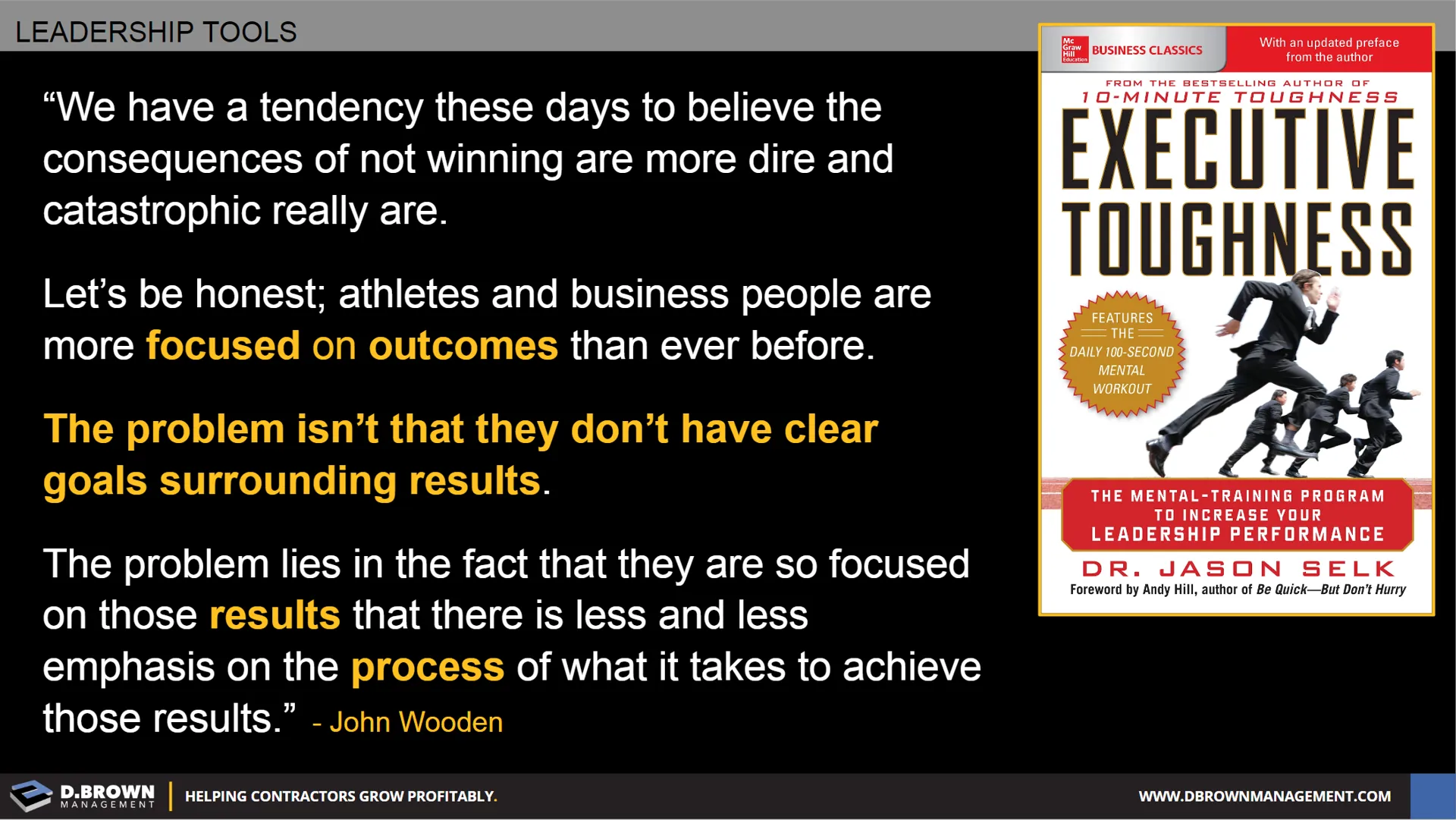
Quote: The problem lies in the fact that they are so focused on those results that there is less and less emphasis on the process of what it takes to achieve those results. John Wooden. Book: Executive Toughness by Dr. Jason Selk.

Whether in the military, sports, or business, few failures can truly be attributed to a failure of strategy or the team really not wanting to win bad enough. The book Executive Toughness describes this well.  

Consistently winning comes from rigorous and daily practice of hundreds of details over years.  

The reason behind many of these details will be completely misunderstood by those going through it the first time.  

Craig Mullaney describes this very well in The Unforgiving Minute:  A Soldier’s Education. 

A great coach (or manager) has the stamina to stick with the rigorous training, providing small corrections to the process along the way.


Think of a contracting business like you would a project. Consider a few major outcomes on your scoreboard.

Which one are you the most unhappy with? 

Drill-down on that outcome metric until you have the equivalent of a Work Breakdown Structure (WBS) and can see the Critical Path.


Correlation Between Culture, Safety, Profitability, and Growth
There is a high correlation between contractors that have consistently GREAT safety records and consistently GREAT profitability, growth, morale, and talent retention.
Building a Systems Development Team - Risk
Minimizing the business risk of a developer leaving. The better you are able to make your company a great place to work (culture & communication), the easier it will be to retain your top talented team members.
Five Mountains - Where Are You At?
As you think about your career and business, there are five basic mountains to climb. Each has its own challenges and rewards. Each has its own peaks and valleys during the climb. Each progressively adds more value to the next generation.