Helen Keller - Blind vs Vision

As a contracting business grows it becomes more important the team is aligned around a common vision and culture.

D. Brown Management Profile Picture
Share

This becomes even more critical if the company has more than one geographic location.  
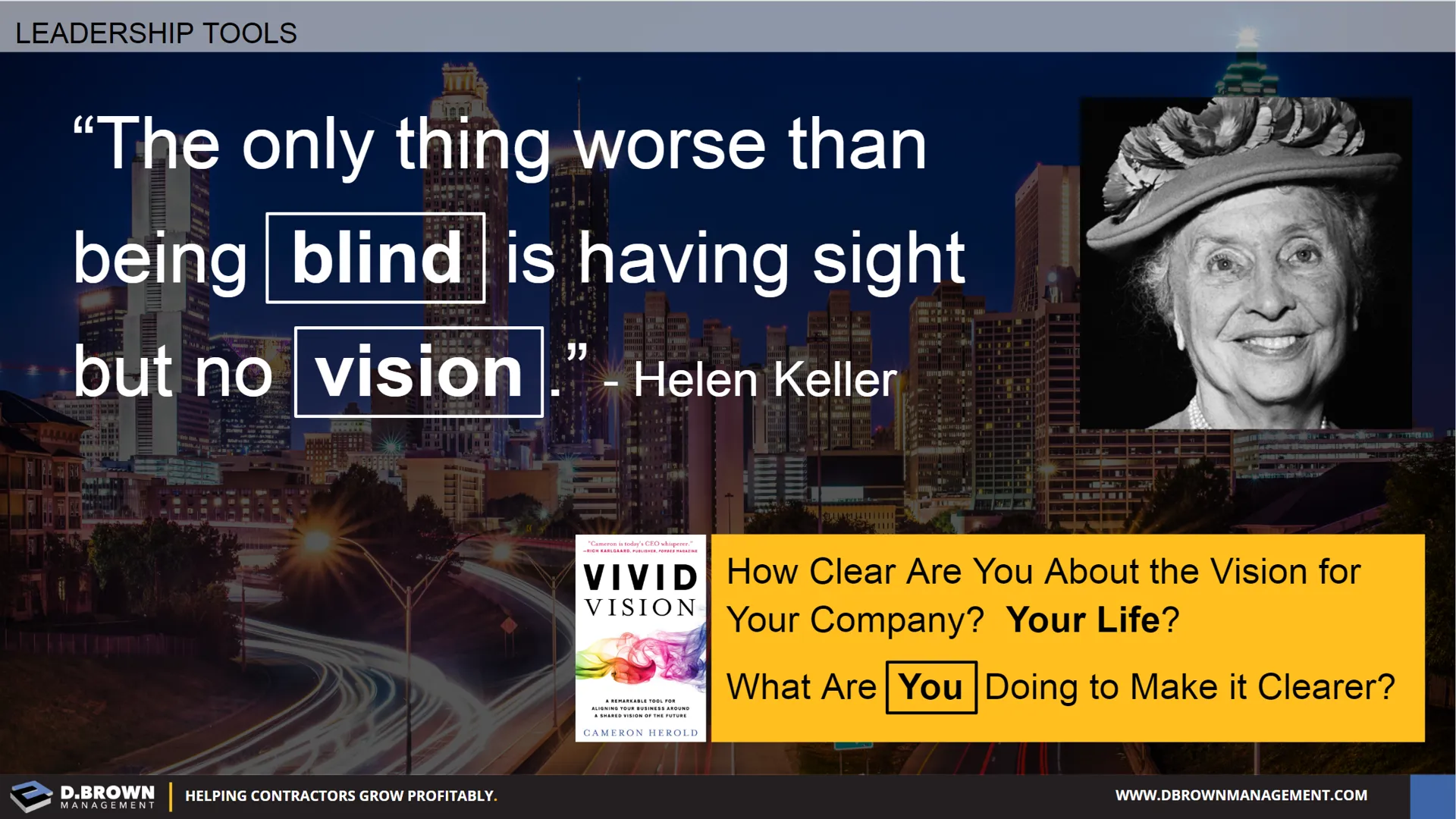
Quote: The only thing worse than being blind is having sight but no vision. Helen Keller.

A company’s vision is defined as the desired future position of the company.  

A company’s culture is defined as the behavioral norms of the group.  

More importantly as Rick Lochner points out - “The culture of any organization is shaped by the worst behavior the leader is willing to tolerate.”

Robin Dunbar’s research points to the average person being able to maintain about 150 stable relationships with team dynamics changing at certain sizes; approximately 5, 15, 50 and 150. 

Managing at each of these levels requires additional structure around communication and process.  This is required for operational effectiveness as well as aligning the team around what Cameron Harold describes as a Vivid Vision.  

At the project level it is nearly 100% about organizing information, material, equipment and labor to build things.  At the senior leadership level of a growing contractor it is nearly 100% about aligning the team around the right vision, mission, strategy and culture.


Weekly Percent Planned Complete (PPC) and Project Performance
Improving the project planning and delivery process starts with improving predictability around the schedule. Nearly every Superintendent and Foreman is familiar with the Short-Interval-Plan (SIP) and typically fill one out weekly looking ahead 1+ weeks.
Retirement Onboarding - Where to Turn for a Helping Hand
Feeling like you’re alone or not sure what the next and best step forward should be? Find out how to get objective input from people you likely already know that have deep experience with these same issues and opportunities around succession.
Strategic Market Experiments
A growing contractor must systematically allocate 10-20% of their resources, including talent and capital to Strategic Market Experiments that have a probability of growing into a major market and becoming a "Strategic Choice."