Seven Drivers of Valuation

A significant number of contractors will be going through an ownership transition during the next decade.

D. Brown Management Profile Picture
Share

These transitions impact many people, especially the owners and the management teams.  
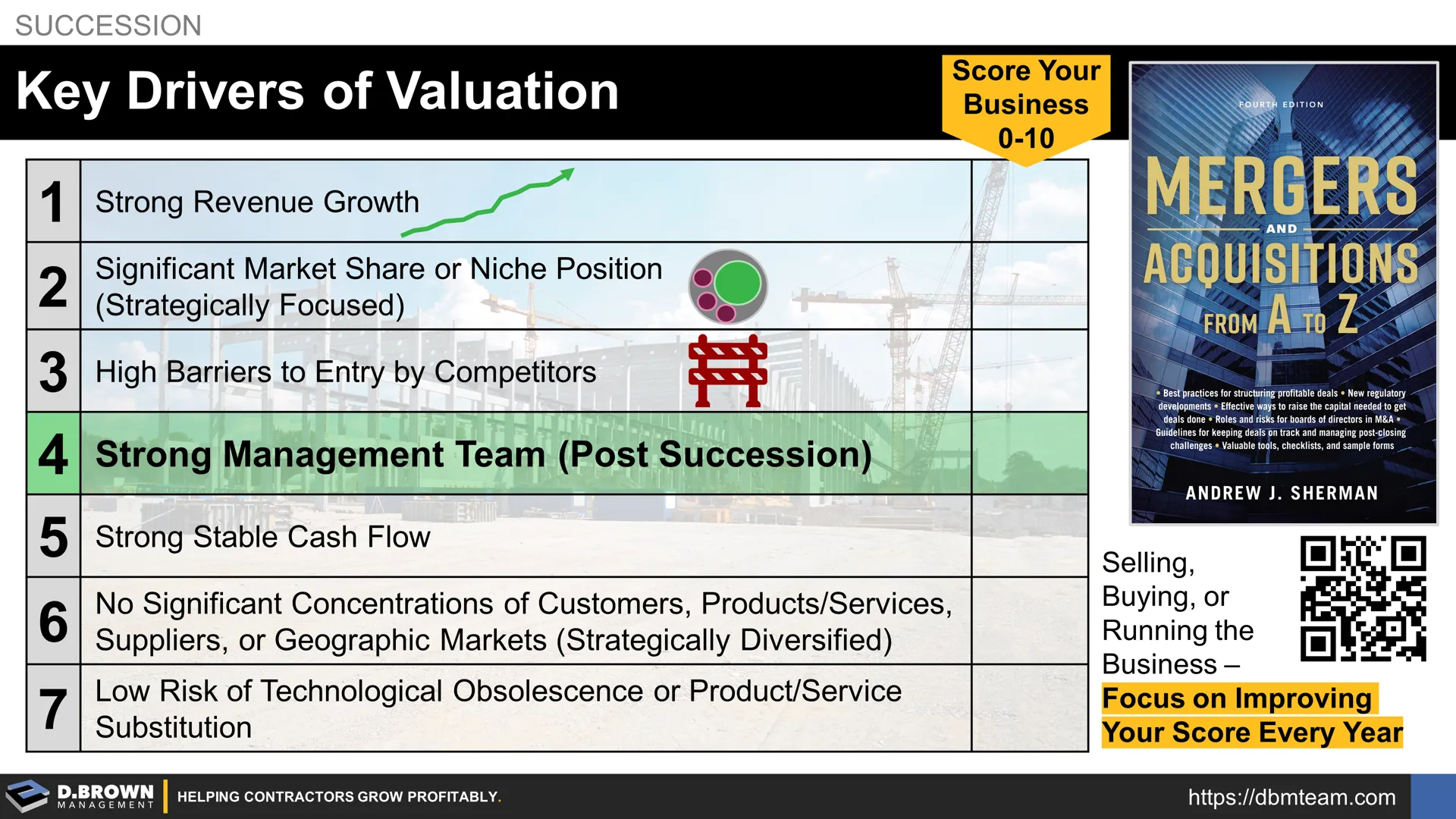
Succession: Key Drivers of Valuation. Book: Mergers Acquisitions From A to Z by Andrew J. Sherman. 1. Strong revenue growth.  2. Significant Market Share or Niche Position  (Strategically Focused)  3. High Barriers to Entry by Competitors.  4. Strong Management Team (Post Succession).  5. Strong and stable cash flow. 6. No Significant Concentrations of Customers, Products/Services, Suppliers, or Geographic Markets (Strategically Diversified). 7. Low Risk of Technological Obsolescence or Substitution

Valuation is a very critical factor during these transitions because it has to be a number that fairly represents the value of the business for the outgoing owners while providing a solid return for the buyers.  

Andrew J. Sherman just published the Fourth Edition of Mergers & Acquisitions which should be read by anyone who is or could potentially be on either side of a transaction. He laid out 7 Valuation Drivers:

  1. Strong Revenue Growth 
  2. Significant Market Share or Niche Position
  3. Barriers to Entry by Competitors
  4. Strong Management Team
  5. Strong Stable Cash Flow
  6. No Significant Concentrations in Customers, Products, Suppliers or Geographic Markets
  7. Low Risk of Technological Obsolescence or Product Substitution

For a contractor, numbers 3 and 7 don’t typically apply. 

Number 4 - Building a strong management team is the leverage point that makes the other factors sustainable in the long-run and, therefore, truly valuable.  


Focus on building your most valuable asset; a strong management team. 


COVID-19: The Only Easy Day was Yesterday
The Only Easy Day was Yesterday. About 15% of our clients are located in California, so last week was a great window into what it will likely look like for other states during the coming weeks.
Can't Learn to Swim Without Getting Wet
Most everything we learn to do in the field for construction comes down to hands-on practice. When we move people into supervision and management roles we often forget the need to truly practice hands-on to get great at doing something.
Be Specific About Problems
The business of construction is filled with constant problems. It’s not that great contractors don’t have problems, it's that great contractors have learned how to troubleshoot first, which allows them to learn from their problems faster.