Agile Project Management vs. Critical Path Method

The Critical Path Method (CPM) of project management is very commonly used in the management of construction projects.

D. Brown Management Profile Picture
Share

CPM works very well when the components of the design and the project are mostly known to all responsible parties. CPM focuses on either a single value-delivery event such as the completion of a building or in major phases such as turning over a floor at a time.  
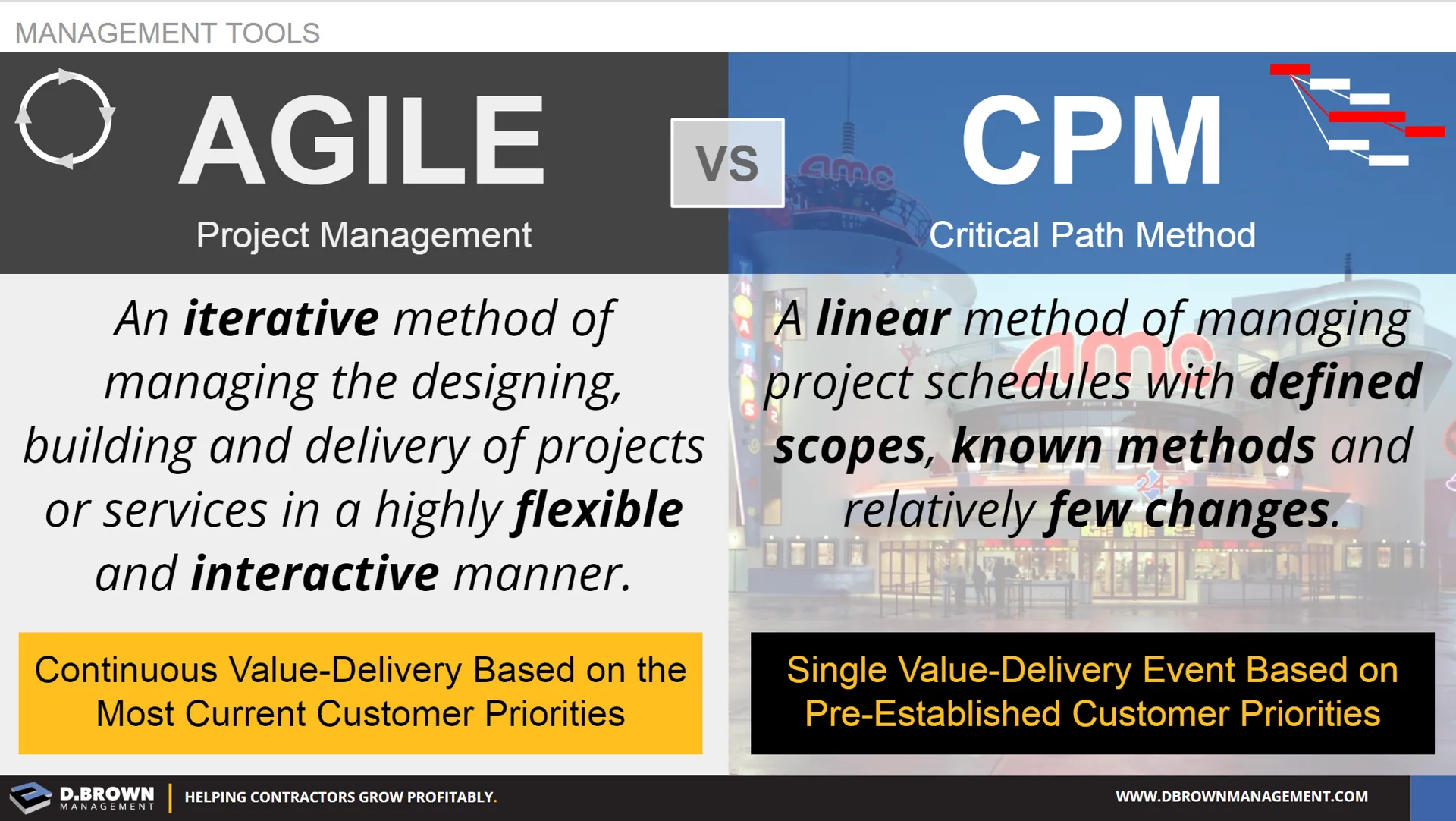
Management Tools: Agile Project Management vs Critical Path Method (CPM).

CPM does not work as well in situations where there are significant “Known-Unknowns” about the plan CPM really breaks down when there are “Unknown-Unknowns”:

  • The final destination isn’t crystal clear; even to the leader
  • The path to get there has unknowns
  • The tools and tactics required to get there aren’t known to the team

In these situations more agile management methods are required either in conjunction with or to replace CPM:

There are similarities between all methods.  Develop the systems that work best for your company at this point in time.


Decision Quality: Data Points, Accuracy, Confidence, and the Danger Zone
Decision quality IS NOT linearly related to information quantity. In complex environments with elements of uncertainty, data quantity quickly reaches a point of diminishing returns but increases decision confidence, which puts you into the danger zone.
Clear Installation Information
For a contractor to maximize their labor productivity, they need to start with clear information provided to the crews doing the actual installation. Good information is the first of the six pillars of productivity and means several things:
Percent Planned Complete (PPC) - Calculation Example
Yoda would be the perfect coach for managing schedules on projects: “Do or do not. There is no try.” This is the heart of Percent Planned Complete (PPC) and the weekly cycle of continuous production improvement.