
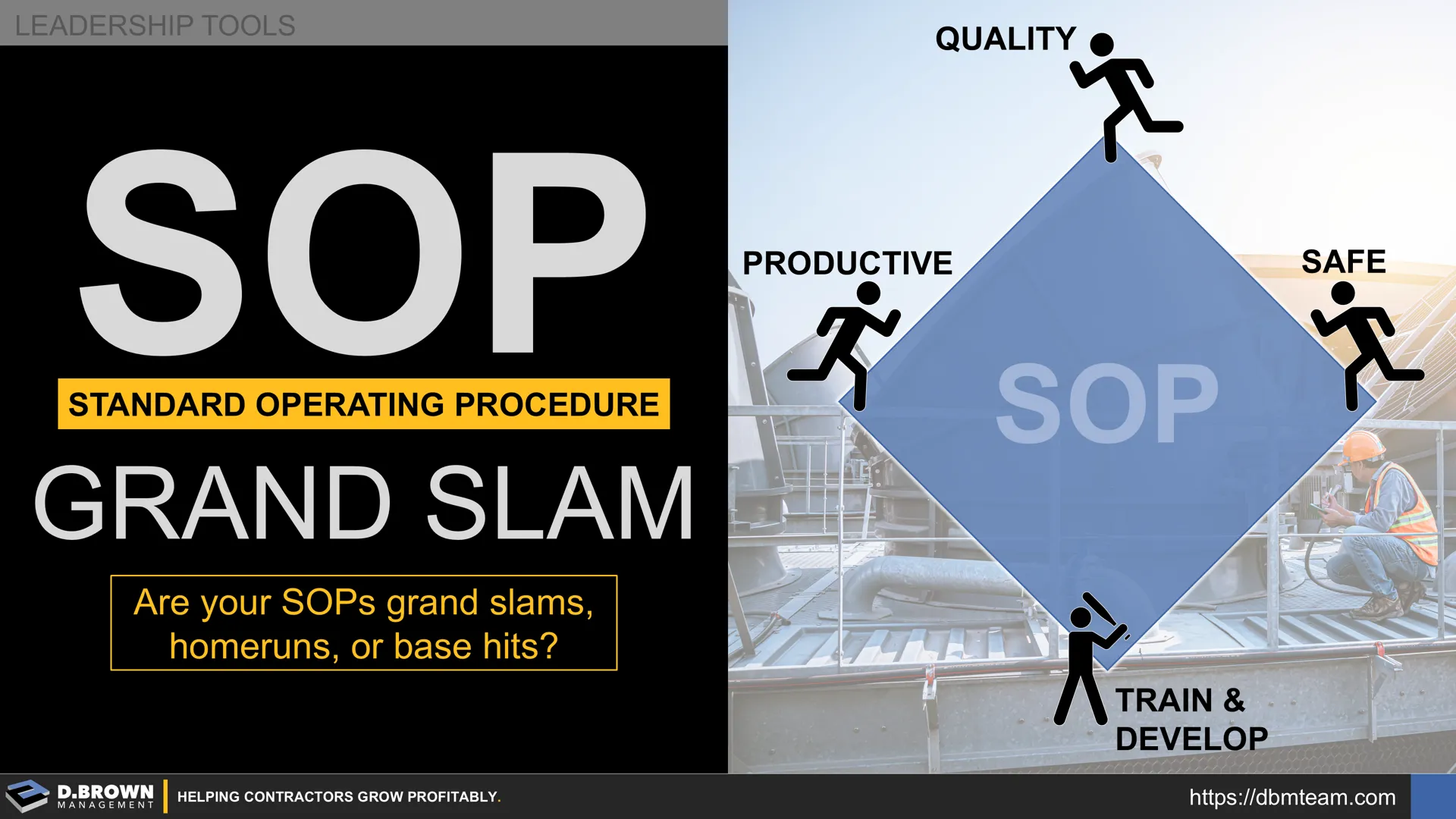
Standards and Standard Operating Procedures (SOPs) are a critical part of building a 1000X Contractor,
All standards for outcomes start with a simple thumbs up or thumbs down from the most experienced or highest-ranking person involved.
With growth, those tribal standards become more explicitly defined and integrated like the building codes. Within a company, the standards for outcomes must be:
Consistently achievable by the people currently doing and managing the work.
Integrated with each other in way that makes the business model work.
With growth, those standards for outcomes progress through six levels of development including leading activities and metrics.
SOPs are fundamental to your management systems. SOPs will always:
Have most of the critical information about how to perform them held in the heads of the people doing the work.
Continuously be improving based on lessons-learned during each cycle of use.
Require changes based on different inputs of material and information, different tools, different conditions, and different people doing the work.
SOPs must be developed in alignment with:
Your stage of growth as a contractor.
Your phase of development as a management team.
Your broader workforce including experience level and desire.
The larger a contractor grows with more specialized functions including purchasing, design, fabrication, safety, and quality, the easy it is for SOPs to become:
Disconnected and sometimes in conflict with each other - like when plans, specs, and building codes are not aligned.
Stiflingly bureaucratic requiring lots of additional work with no value-add.
Systems that people "game" in order to comply.
A false sense of control from leadership, and even those doing the work that introduces significant underlying risks like a sinkhole opening up "suddenly" beneath a busy and newly paved intersection when the reality is that it was building for a very long time.
Increasingly more disconnected from the way work actually happens (SOPs for Show).
What is a SOP Grand Slam?
The bases are loaded with safety, quality, and productivity. When a system is designed and managed effectively, these three are not at odds with each other. They are working together in synergy (1+1+1=4) delivering optimum results. At bat is training and development, or more holistically, organizational development.
Does the SOP define prerequisite levels of knowledge before starting including certified competency levels if required?
Does the SOP allow other people who are experienced opportunities to practice training someone new to do the task?
Does the SOP define how supervisors and managers can check the quality to ensure consistency of outcomes?
Does the SOP allow you to evaluate and track individuals through each stage of their development?
Where to Start Building an SOP Grand Slam?
Contractors at all stages of growth benefit from integrating three levels of SOPs at the project level. Lessons learned in this process can be applied throughout the company. We choose these because they occur at a high frequency, so you see what is and is not working then adjust quickly. They are also seemingly "simple" causing nearly everyone on team to think there is little improvement that can be made.
A team's willingness to dig into the seemingly simple and the stamina to continuously evaluate then improve a process occurring every day says a lot. The three integrated levels of SOPs are:
Pick the three highest frequency installation tasks performed on your jobsites. Look at your estimates and the most frequently occurring activities will be obvious with just a little data analysis. Defining each of these as SOPs including tools, equipment, safety, quality, and production standards tied back to estimating and project or location specific specs is harder than it seems. Ensuring everyone is trained and working consistently within these standards is an order of magnitude harder.
Daily SOP for how work is planned, crews are laid out, work is verified, impacts and improvements are identified, escalations are communicated where required, and tomorrow's plan is adjusted accordingly.
Weekly project team SOP built around the Short-Interval-Plan (SIP).
These three SOPs can be built into a very effective Foreman Coaching Program.
Notice that this ties into what we call the Field Productivity Grand Slam. :)
Getting into more details of how to apply these in your company is beyond the scope of this article. We will freely share any lessons we've learned that will help your project, company, or career. Just contact us and schedule time to talk.
"All relationships begin with a simple conversation."
