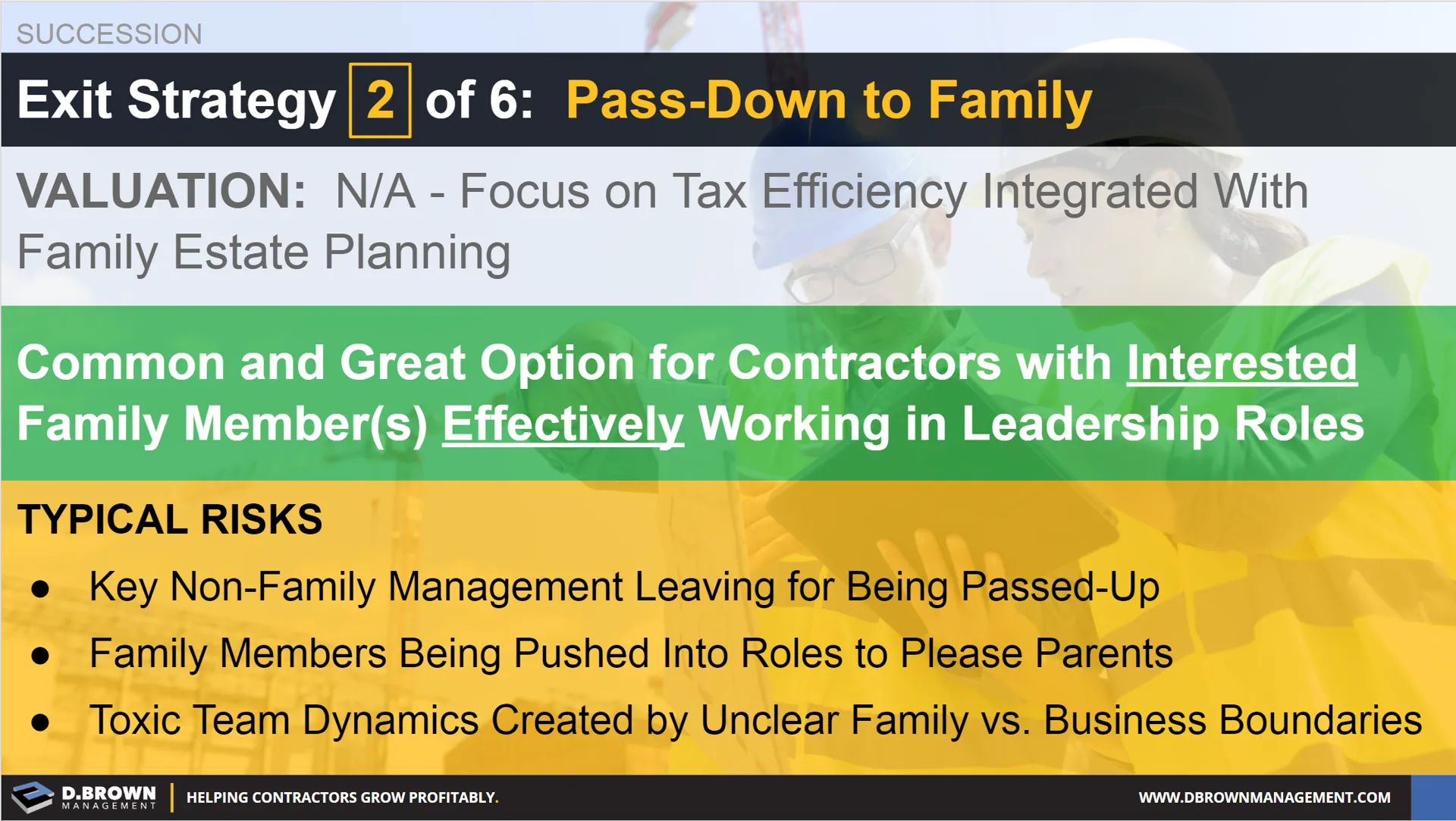
Contractor Exit Strategy 2 of 6: Pass Down to Family

This is a very common strategy for contractors and is successful for those with interested family member(s) who are effectively working in leadership roles.

D. Brown Management Profile Picture
Share
Succession: Exit Strategy 2 of 6 - Pass-Down to Family.

The valuation focus for these deals is on tax efficiency and risk management by tightly integrating the transaction with estate planning. The upside is that there are typically solid tax savings with this type of deal.

The typical downsides of these deal structures include:

  • Deal structures that potentially make adding non-family members as equity partners difficult. 
  • The deal structure keeping the incoming owners from feeling the full weight of their capital-at-risk that would typically be felt by a non-family buyer. This is a very underestimated dynamic that often negatively impacts professional development and business performance significantly. 

Other common risks include:

  • Key non-family management team members leaving if they feel they are being passed up, which is why there is a huge burden for family members to be effectively performing in leadership roles prior to succession.
  • Family members being pushed into roles they don’t want to please their parents, which negatively impacts them personally, the business performance, and family dynamics.  
  • Toxic team dynamics created by unclear boundaries between family and business. 

Contractor Exit Strategy 2 of 6: Pass Down to Family
Continue building value in your business, yourself and your key team members with a good succession strategy....

Contractor Exit Strategy 2 of 6: Pass Down to Family
Continue building value in your business, yourself and your key team members with a good succession strategy....

Control, No Control, and What Matters
Every person, team and business has a finite amount of resources. It is how we choose to use those resources that determines the level of our success, the speed we get there and our joy while on the journey.
Job Role Complexity: Four Major Factors
Job roles have varying degrees of complexity requiring different types of people to fill the role. Understanding the four major factors will help with job role design, organizational structure, and selection of the person for the role.
Connecting Metrics to Activities and Outcomes
Outcomes are created through doing the right activities. Data is only a proxy for that activity and a metric is a synthesis of lots of data points. Metrics are valuable, but always have a skeptical view of proxies for performance, especially with growth.