
This seems so incredibly obvious and simple but in reality it is very difficult to do for all but the smallest and simplest of contractors.
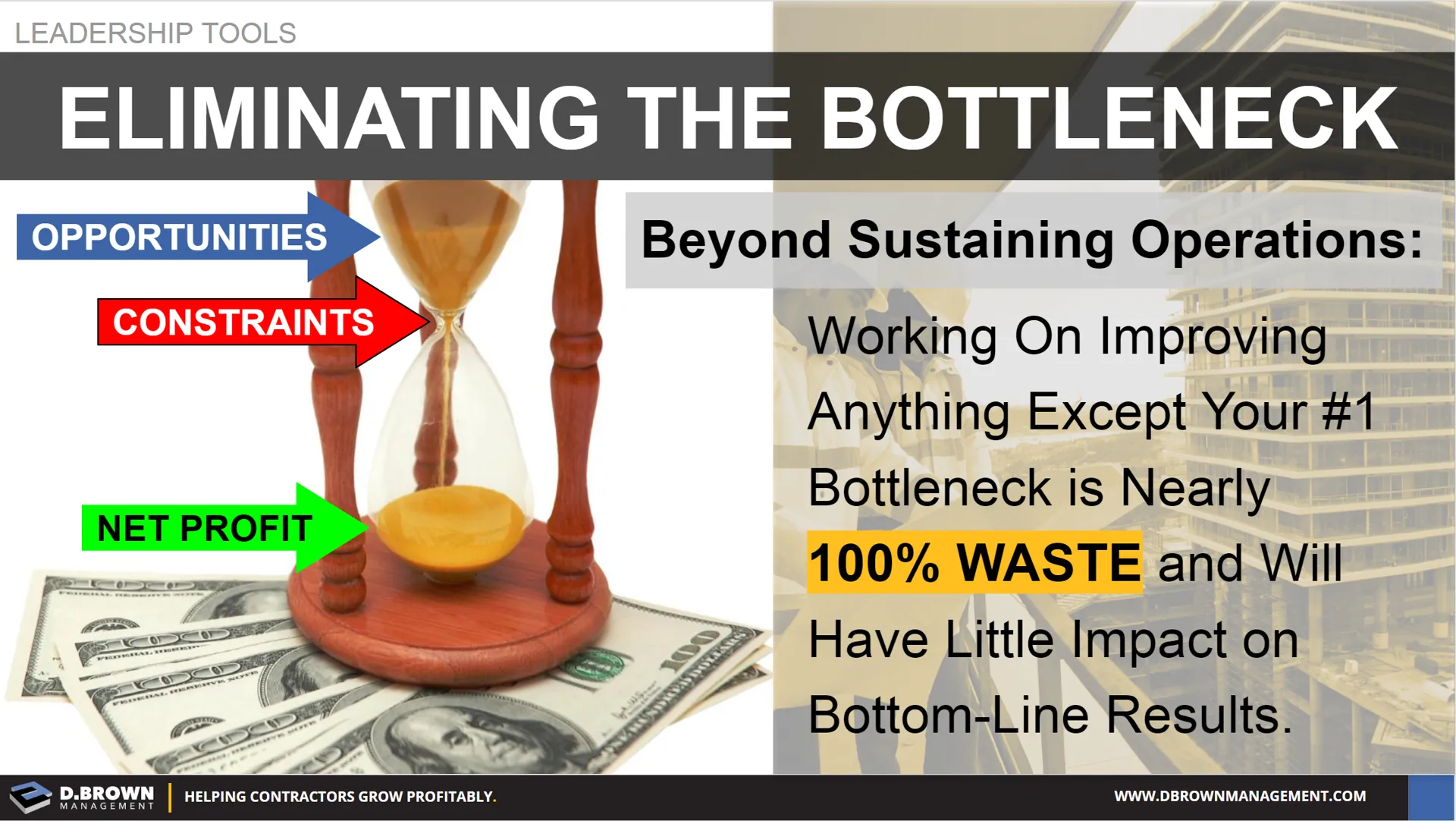
Let’s dive into this a little:
- Imagine your business as one linear pipe with a set of plans along with a paying customer being pulled into the front of the pipe along with a set of project requirements. Out the other end of the pipe comes a completed project for them and profit for you.
- In lean terminology every step along the way inside this pipe this is considered your value stream.
- Now imagine that there is one place in that pipe (value stream) that is narrower than the rest. Just like a water pipe the flow through to the other end is limited by the narrowest point - the bottleneck.
- If you really want to increase water flow (profits) then you need to eliminate that bottleneck as quickly as possible. Then go find the next bottleneck and eliminate that one as well.
- While it might be nice to treat your business like it is a water main that needs to be upgraded from a 12” to a 24” down the whole street the truth is that it doesn’t work that way in business. You can improve sections at a time and it really only pays to give yourself 20-30% more additional capacity in each area as you eliminate the bottleneck.
Take a look around your business and ask yourself if you are truly focusing as many resources as you can on eliminating your #1 bottleneck?
Do you even know what it is? Does everyone else?
