Retirement Onboarding and Ownership Transitions

The onboarding and integration of a new team member is something contractors should rigorously manage.

D. Brown Management Profile Picture
Share

The best contractors do this as one of the 9 critical talent processes. What we don’t always pay as close attention to is what Sue Weiler-Doke frames as “Retirement Onboarding.”
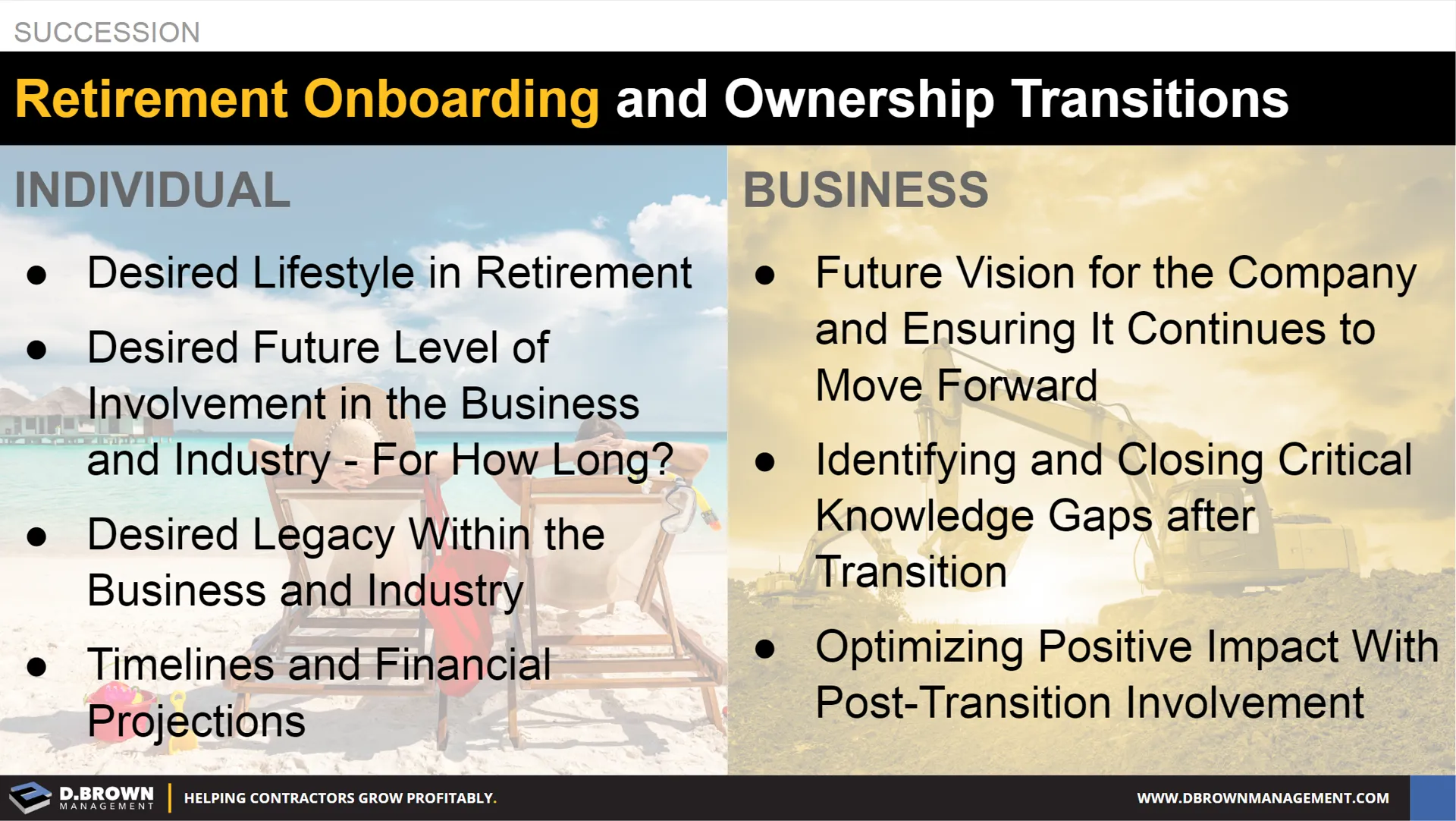
Succession: Retirement Onboarding and Ownership Transitions. Comparing Individual and Business goals.

This is critical for all key technical and executive roles as people retire. Due to the demographics in the United States, we will have a huge deficit of experienced talent over the next ten years.

Retirement Onboarding is even more critical during ownership transitions because often, the current owner has had nearly their whole life -- 20 to 40-plus years -- wrapped-up in the business. Many of the best business operators have given relatively little thought to their personal retirement.  

With decades in their roles, they are typically involved in many areas of the business and their retirement will create unforseen knowledge gaps. 

Retirement Onboarding must be approached with the same rigor as the rest of the retirement process and should follow similar phases. 

An experienced advisor can help owners effectively navigate their own path as well as help the company create Retirement Onboarding processes for other critical roles, ensuring sustainability.


Retirement Onboarding and Ownership Transitions
Continue building value in your business, yourself and your key team members with a good succession strategy....

Retirement Onboarding and Ownership Transitions
Continue building value in your business, yourself and your key team members with a good succession strategy....

Summary Definition: Aptitude X Desire X Learning and Practice = Capability and Capacity
This is the basic formula that determines what an individual and team will have in terms of capability and capacity.
Four Steps to Sustainable Growth (10+10=0)
Growing contractors face an overwhelming number of problems and opportunities as they move through the different stages of growth. Prioritizing these, aligning the team, then executing becomes progressively more difficult and important.
Attracting and Retaining Talent: The Five Most Important Questions
To attract and retain the best talent, everyone on your team must be able to clearly answer these five questions. Your answers must be competitive with the other choices a potential new team member has.