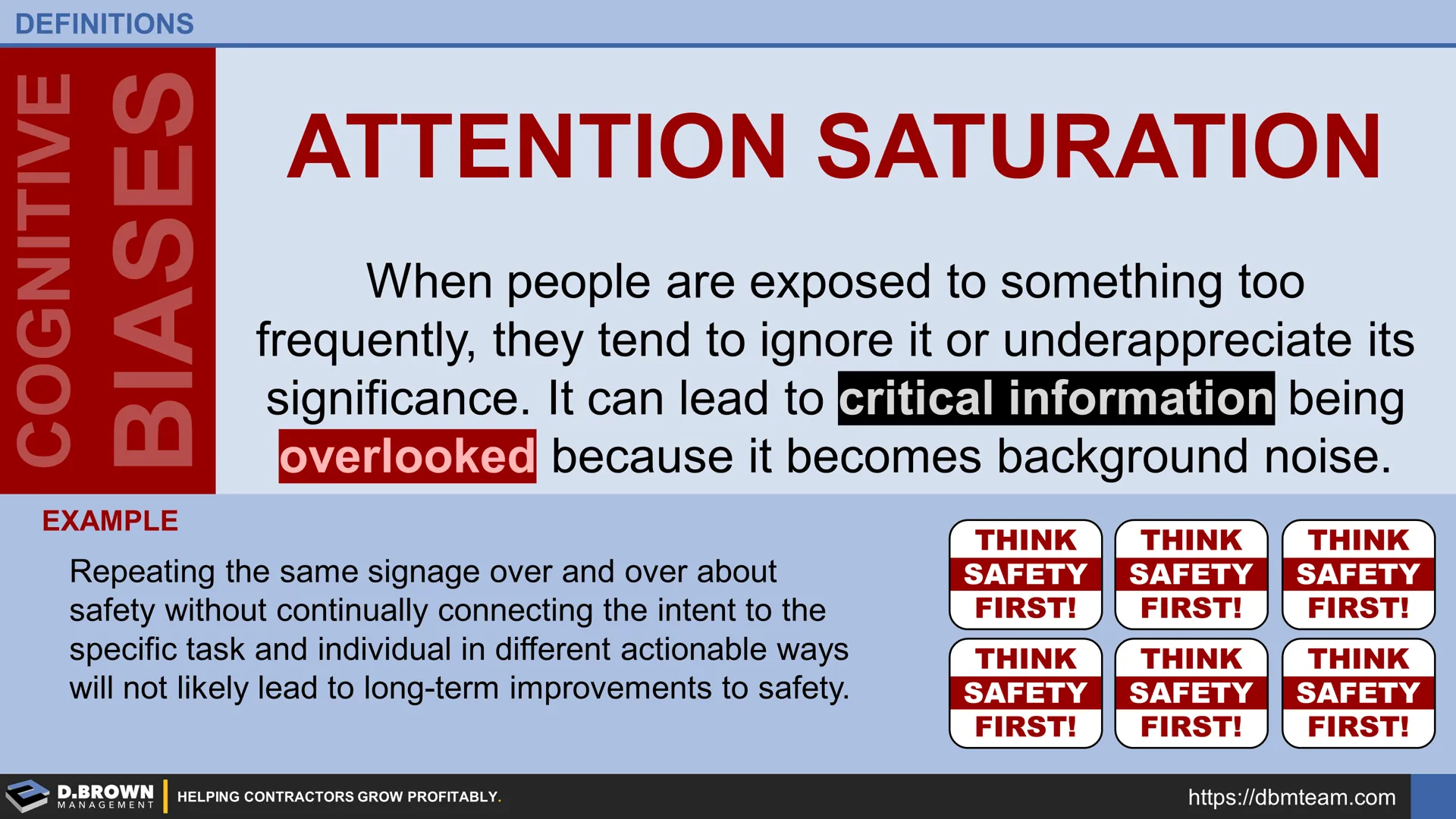
Definition - Attention Saturation Bias

When people are exposed to something too often, they tend to overlook it or underestimate its significance. This can cause critical information to fade into the background and be ignored.

D. Brown Management Profile Picture
Share


EXAMPLE

Repeating the same safety signage without consistently linking its purpose to specific tasks and individuals in meaningful, actionable ways is unlikely to result in long-term safety improvements.


Signage is only a small part of developing a true culture of safety, supported by management systems

The same could be said for repeatedly seeing the same information on job cost or other financial reports.

When this happens over and over, it can lead to a culture where deviations from correct behavior or rules become culturally normalized.


LEARN MORE

Attention Saturation is closely related to "Normalization of Deviance," which is described very well by astronaut Mike Mullane talking about the Challenger and Columbia disasters. 


Management's role is to take general principles, like "Think Safety First!", and connect them to the specific tasks and contexts relevant to each person they are responsible for. Sometimes, this involves telling a story. Other times, it may require training on a specific task or tool, coaching while observing, or asking questions to validate how others are thinking. 

This is the role, responsibility, and skill of good managers


Definition - Attention Saturation Bias
Building a project requires knowledge of, and skill in using thousands of construction-specific definitions, acronyms, and metrics. Building a business including the development of people has its own vocabulary forming the foundation of communication....

Related Training
Definition - Attention Saturation Bias
Building a project requires knowledge of, and skill in using thousands of construction-specific definitions, acronyms, and metrics. Building a business including the development of people has its own vocabulary forming the foundation of communication....

Functional Time Horizons
Starting out, the time horizons for strategy, winning work, and doing work are similar. As a contractor grows from 150 people to 500 people and beyond, those time horizons must stretch further apart while remaining integrated.
Multiple Dimensions of Talent
People are muti-faceted, there is no precise way to measure any dimension, and people are constantly changing. Understanding just some basics about the various dimensions of talent can help you be a better manager and design better jobs.
Strategic Market Experiments
A growing contractor must systematically allocate 10-20% of their resources, including talent and capital to Strategic Market Experiments that have a probability of growing into a major market and becoming a "Strategic Choice."