The metrics cited above are just averages and there are many ways of calculating them. That is way beyond the scope of this article - remember that benchmarks are only valuable with context. There is also a lot of other value that comes from having a child or adding a team member than purely economic value - NEVER lose sight of that.
"It would be nice if all of the data which sociologists require could be enumerated because then we could run them through IBM machines and draw charts as the economists do. However, not everything that can be counted counts, and not everything that counts can be counted."
- William Bruce Cameron (from 1963)
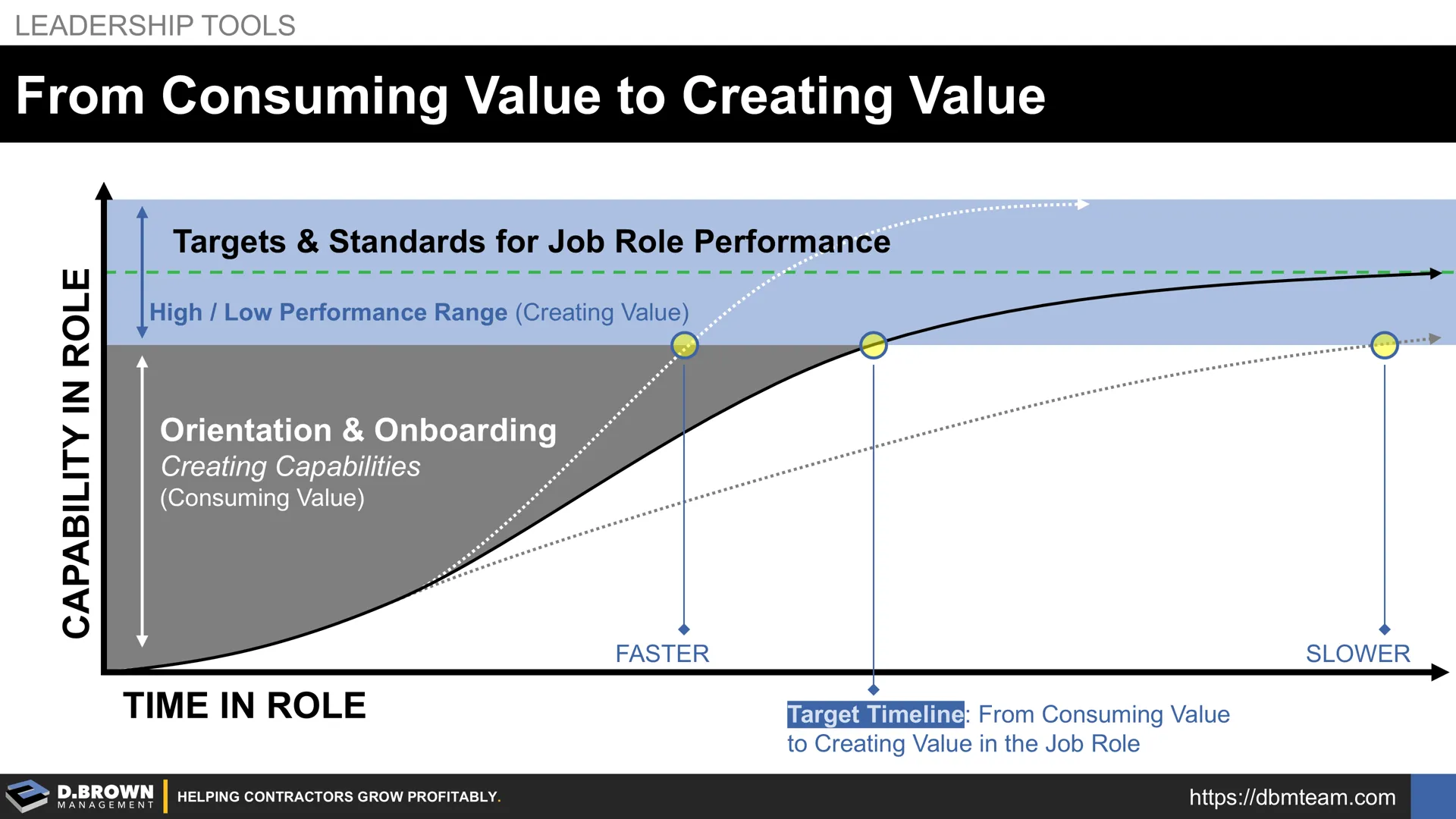
From Consuming Value to Creating Value to Break Even Timelines
There are multiple dimensions of talent so when we use the term "value" in this article, it is referring collectively to a wide range of value that a person adds to a team when joining - economic value just being one of those dimensions. The economics must be there for the business model to work, but that is not nearly the total value someone consumes or creates. With any given job role, you are ultimately trading a certain amount of input (compensation) for consistent outputs (key results).
For any person joining the company, transitioning to a new role, or moving to a new project, there is a timeline and curve where the move from consuming value to creating value. The consumption of value is mostly a combination of recruitment costs, compensation, management time, and training.
Once the transition is made to creating value, there is another point further down the timeline where the total value created is equal to the total value consumed. That is the break-even point and not shown on the graphic above.
The timeline from start to break even may be measured in hours for some front-line positions focused on a few specific technical tasks, or in 2 to 3 years for a President/CEO succession or someone building a first-of-a-kind function like VDC, manufacturing, or supply chain. Roles like an Estimator, Project Manager, or Superintendent will be in the 6-12 week range.
How the entire onboarding process is handled from job offer through full integration into the team and role can dramatically shift the timelines.
There is no single magic solution. This is a combination of dozens or even hundreds of details including communication, scheduling, and sequencing of work. It takes a lot of planning, continuous improvement iterations, and deliberate practice to get right. The manager directly responsible for the integration of someone must tailor the system to the individual as each person and situation will have variations.
At the executive level, Michael Watkins has built a great body of knowledge including The First 90 Days book. For the higher-volume roles, it starts with clarity of the job description down to the specific behaviors, competencies, capabilities, and capacity required.
What's the target level of performance?
What's the minimum acceptable standard?
To what level are your standards for tasks the role is responsible for defined?
How, when, and who trains a new person to those standards?
How does the manager and manager once removed evaluate progress and provide actionable feedback?
Retention and Reputation Risks (And Mitigation Tips)
Remember that this curve and timeline is felt by everyone on the team even if they aren't describing it in these terms. Look at it through the lens of the new person, especially when they are first joining the company. Everyone will feel these things to a different degree at different times. A good onboarding process will both accelerate the timeline to break even while minimizing negative feelings. A few pointers that will help are:
Learning is an uncomfortable process for nearly everyone. A good process keeps people in their learning zone and out of their panic zone.
The majority of "learning" for everyone is deliberate practice - application of what they have learned getting iteratively better at each cycle until they've moved into the comfort zone. As cool as it sounds, no one can continually be in the learning zone. That's not good for the person or organization.
What you ultimately want is for someone to have "Comfortable Capabilities & Capacity" in their role, meaning that even on a day when they aren't at their best, they are overloaded, and nothing is going as planned, they can still deliver. If someone is stretched every day, then it is just a matter of time before failures in outcomes and turnover occurs.
Plan and assign work so people can learn something, get repetitions in, and receive actionable feedback over a relatively short period of time. This is how they build comfort and competence. The Bruce Lee quote holds true for all job roles: "I fear not the person who has practiced 10,000 kicks once, but I fear the person who has practiced one kick 10,000 times."
If a job role requires bringing together 50 specific competencies (identifying RFIs, pricing change orders, building a submittal log, etc.) then you can start with learning and processing just a few tasks at a time. This moves someone into value creation right away for those tasks while they are still learning everything required for the role. While this may seem like the slower path than just dropping them into a project and having them FITFO (Figure it the F* Out), it will nearly always result in better outcomes in the mid and longer-term. Especially when they are helping bring other new people up to speed. This is also what keeps your company from having 10 Project Managers and 10 Project Management Systems creating confusion as PEs, APMs, Foremen, and Superintendents interface with each.
Remember that if they have been in the role before at another company, they will be excited to share things they have learned. The art of good management and training is to not shut this down while also maintaining your standards. Focus on training, practice, and feedback to get someone up to your standards for the task while listening to how they have done it at other companies. Look for potential improvements you can make to your standards and work those through your continuous improvement process while not abdicating your responsibilities as a manager and/or trainer.
Most people will hesitate to ask for help for a combination of reasons including:
Not wanting to look "dumb"
Not wanting to interrupt another team member or their manager.
Not knowing who to ask for what.
Not even recognizing they need help (Unconscious Incompetence / Dunning-Kruger Effect).
This is where routine work observations and check-ins come into play. Encourage asking questions. Encourage learning. The basics of this haven't changed. When it comes to training people, what worked in the 1940s still works today. Our DNA is the same today as it was thousands of years ago.
Engage everyone on the team. "It takes a village to raise a child" applies in the workplace as well. We have strayed from that wisdom as a country and are paying the price in both mental and physical health. We can start to correct that with how we treat new team members. Changing your culture to where everyone prioritizes building relationships with and helping a new team member learn your systems will have dramatic long-term impact on your scalability and the joy you experience in your career.
You worked really hard to recruit this person to the company. They took a risk on joining the company. You want to make this period of integration great from all perspectives.
For the new person joining, every day should reinforce the decision they made. You want them telling their family and friends how great everything is. This does not mean lax standards. It does mean following through on commitments made during the recruiting process, including holding to those values and performance standards. This is great for the individual and great for your reputation, helping attract and retain talent.
Other team members should be embracing the process of integrating a new person to the team, building new relationships, and learning from them as well as teaching. This is what makes careers, contractors, communities, and countries stronger.
From the manager through to the CEO, you need to be both creating value for the organization and for their career.
Also remember that there will be similar degrees of feeling this way when someone is moving to a different role, a different team, different project, or different location in the company.
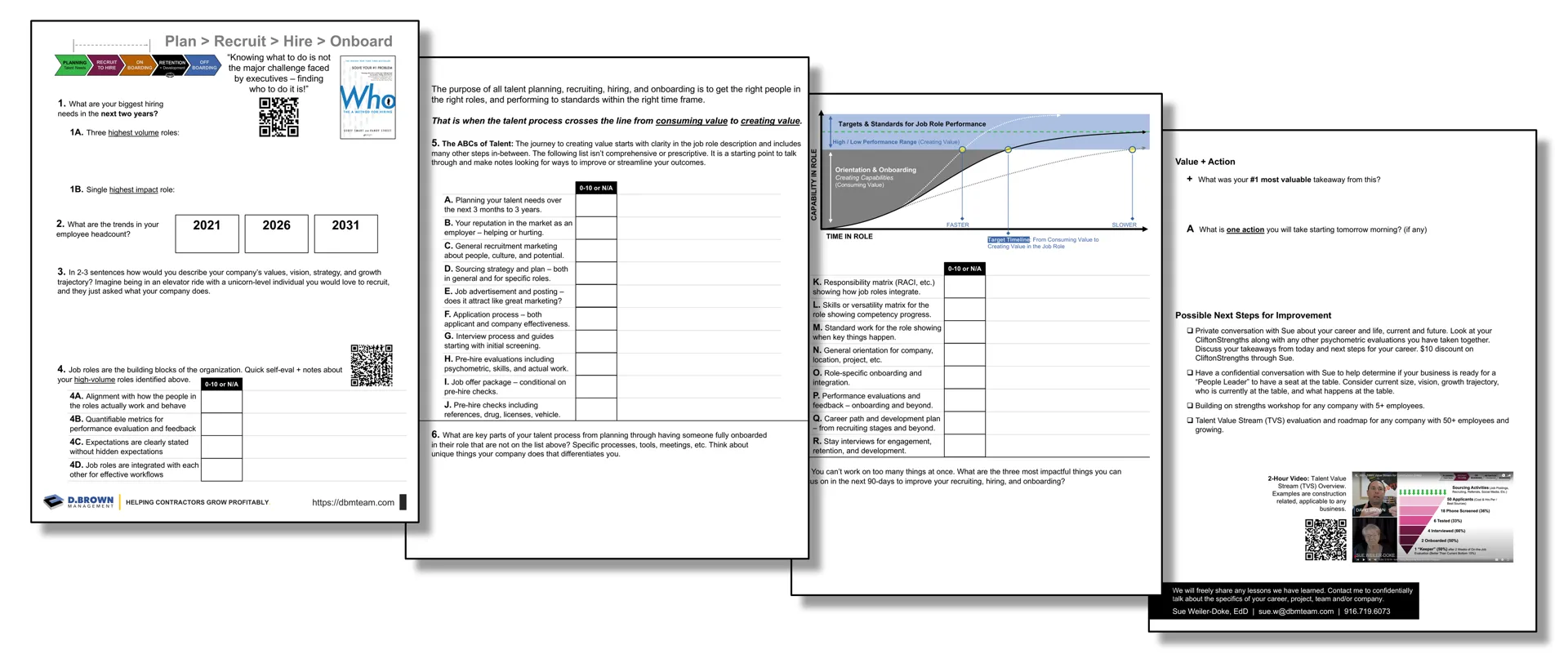
Recruit-to-Onboard (Evaluation + Next Steps Discussion)
The principles are straight forward but the application varies widely based on the job role and your stage of growth as a company. Recruit-to-Onboard is just one part of the broader Talent Value Stream (TVS) for a contractor and that is only one part of a contractor's total business model.
We have created a structured discussion guide to help evaluate your current situation and narrow down your priorities around onboarding. Schedule time to talk.