Ownership Transition and Capital Basic Model

When a contractor goes through an ownership transition, the business itself is the proverbial goose laying the golden egg.

D. Brown Management Profile Picture
Share

Remember the basic math formula for ownership transitions

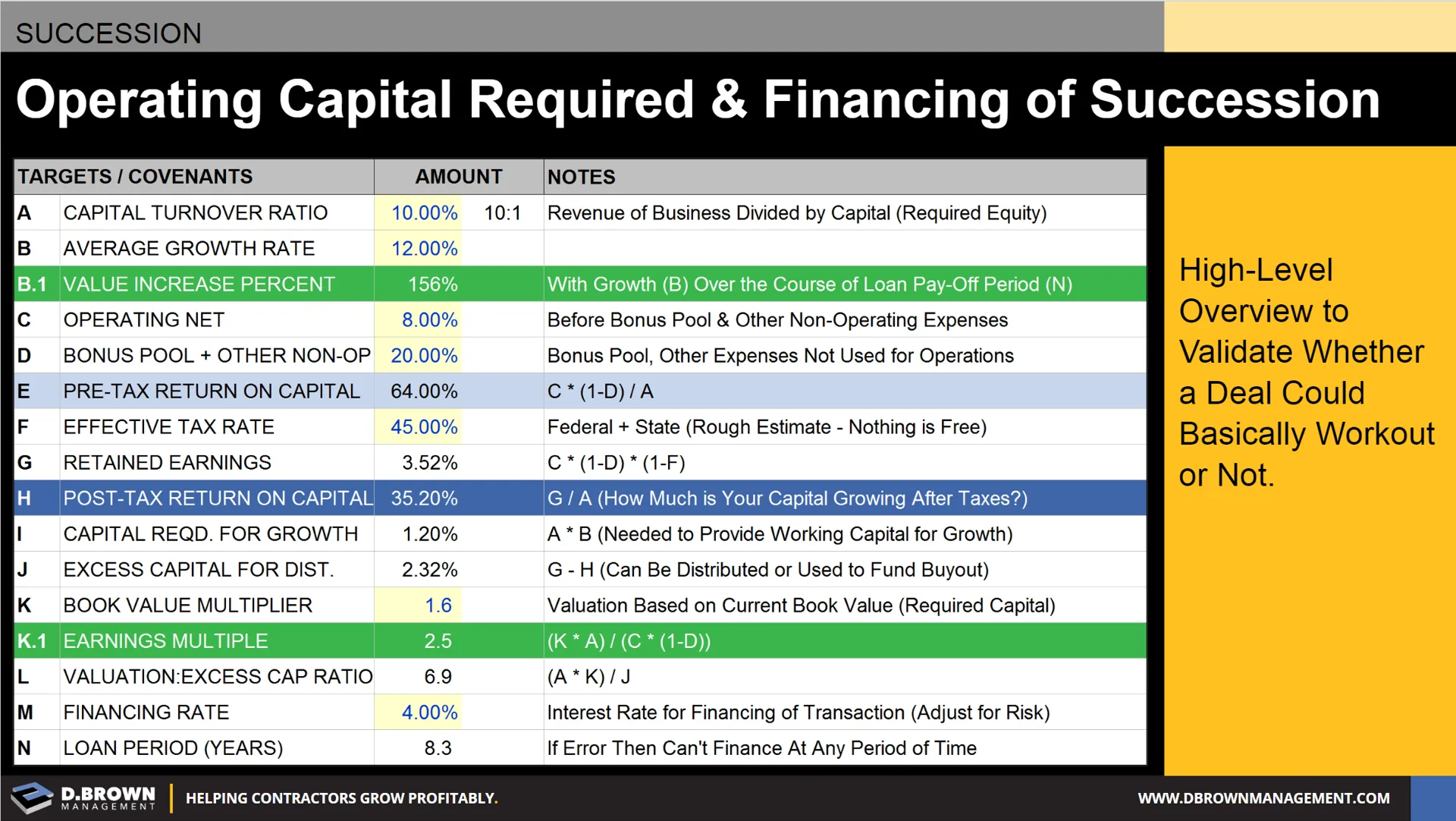
Linkedin Basic Succession Capital Calculator

With that in mind, we often start with this simple calculator to look at the company’s ability to generate the cash required for a deal.

With some very basic numbers. Doing so allows all parties involved in a transaction to see what will generally work. We consider this the parallel to the initial conceptual sketches and discussions at the very beginning of a construction project.

You can tell all the basics from this model, including capital levels, future projected value growth, and estimated pay-off periods. When you have a few concepts that will generally work, you can build more complicated models and bring in advisors to help with the “Value Engineering” phase

There is no sense modeling a deal structure if the basics won’t work. Remember that no deal structure will “create” capital

Contact us to get a copy of this workbook that includes several worksheets that are helpful at these initial stages


Ownership Transition and Capital Basic Model
Continue building value in your business, yourself and your key team members with a good succession strategy....

Ownership Transition and Capital Basic Model
Continue building value in your business, yourself and your key team members with a good succession strategy....

TOOL: Model Your Business, Prioritize Improvements, and Execute
Contractor Business Model template you can customize to represent the current and future state of your business. Use this model to identify bottlenecks and constraints to your growth. Learning guide for your team based on The 4 Disciplines of Execution.
Management System Hierarchy Example
A management system has hierarchies from culture through to the individual steps in a procedure. These hierarchies must be integrated with strategic decisions, the organizational structure, and training to create a competitive advantage.
Issue 3 of 9: Relationships
Construction Ownership Transition Issue 3 of 9: How Strong are the Post-Transition Relationships with Customers, Employees, Vendors, and Subcontractors?