
Decision making is hard. It is learned painfully over a long period of time. It is mostly learned through the school of hard knocks, which makes Harvard's tuition look cheap by comparison.
Good judgement comes from experience. Experience comes from bad judgement.
As each of those lessons is learned, your situational awareness increases. What you perceive in the environment sharpens as does the speed which you connect the dots together and project multiple scenarios forward. In the military, this is referred to as the OODA (Observe, Orient, Decide, and Act) loop.
As you run through this cycle over and over, you get both sharper and faster. Not sharper and faster by percentages, but by orders of magnitude. If you are also great at delegating clear tasks to others and relentless with follow-up, you can deliver incredible results.
Think about that superintendent who can walk a project in 90 minutes, generate an 8-page punch list, spot a schedule constraint four weeks before it becomes a problem, and lay out a precise action plan while driving to the next site.
That is the foundation for scaling.
It is also a seductive trap.
Toyota's chairman described these problem-solving capabilities as ranging from 3 months to 3 minutes.
When you are at the top of your game, you can identify and solve a lot of problems. If your evaluation, promotion, and compensation systems are only aligned with measurable outcomes, you are highly incentivized to concentrate decisions, delegate actions, and follow-up.
You can build a business, team, or project that checks many of the success boxes that way.
The only box not checked at first is succession readiness but that doesn't usually matter in the early stages of career and contracting.
You continue to scale - larger company, larger team, larger and more complex projects.
Your schedule becomes increasingly more efficient. You have information coming into you from a wide range of sources. You are making decisions of a higher quality and faster than ever. Your ability to delegate tasks and follow-up is top tier.
Gradually your work time and days extend to their upper limits. You can solve three problems while waiting for dinner with your family. Another half dozen while at your kids' game on Sunday.
You are making more money than you've ever made before which is the typical condition just before the cracks start to show. This is the seductive part of the trap as it is often very validating that you are doing things right.
Everyone has upper limits of working memory, cognitive processing, and working hours. When you are running maxed out, there is no slack. It's the heart rate equivalent of being in zone 5 versus zone 2.
You start having some misses in delegation and follow-ups.
You've tried delegating some decisions to your team, but they aren't as fast or sharp as you are.
You don't have time to recruit, select, and train new people for the team.
You've built a "hollow" team. This may be at the project level, team level, or company level. Often at all three levels if that is the culture.
Now you are at the trap that feels like there is no way out. You are out of time yet have contractual obligations to meet. Your best is no longer good enough and there is no more to give.
Nearly everyone has been at this point to some degree at some time in their careers.
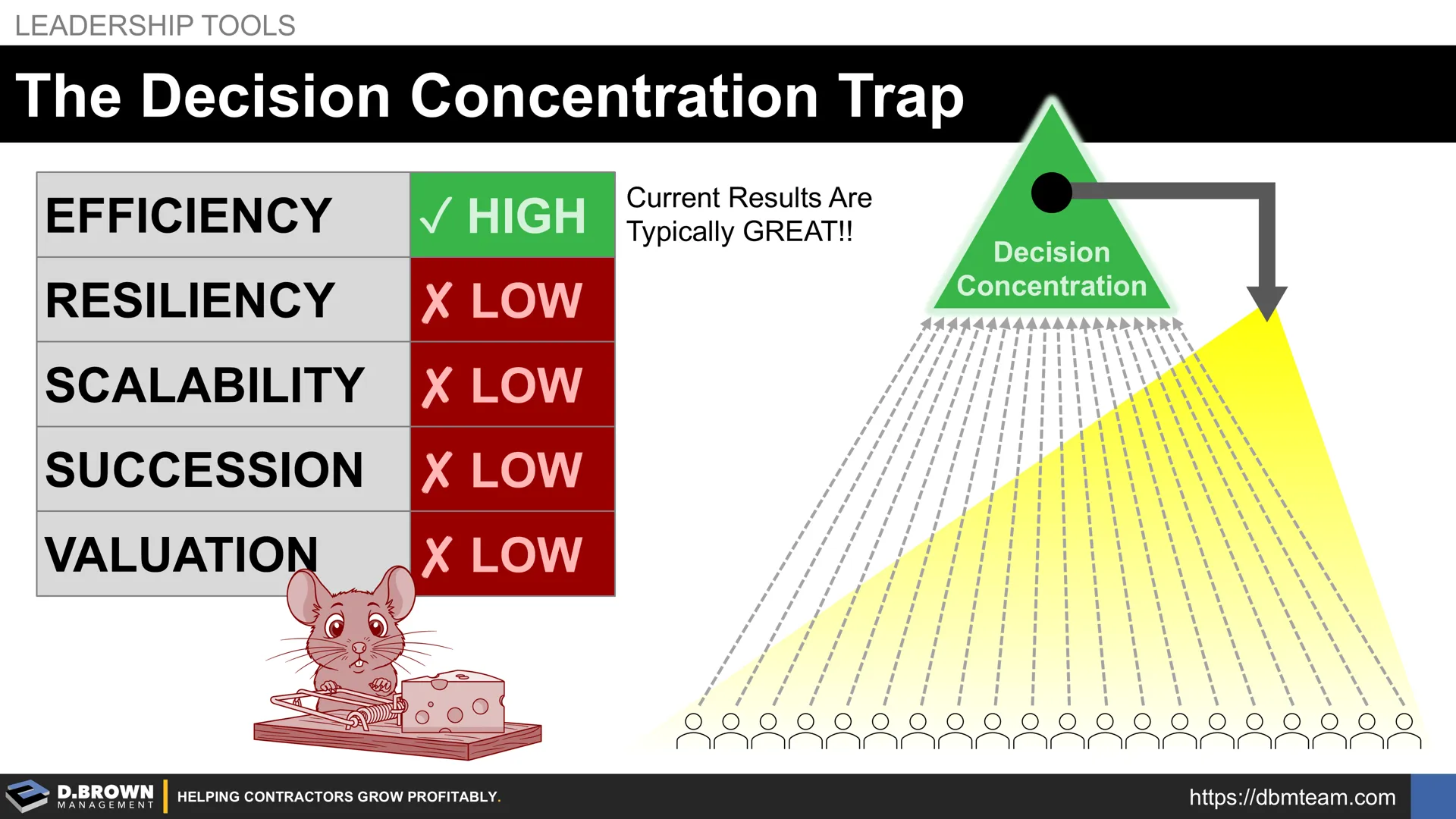
Efficiency is still high, but cracks are starting to show.
Resiliency is low - it's nearly all on your shoulders.
Scalability into the future is low - the growth engine of your own efficiency is now out of steam and there is no one to take the baton forward and build on the lead you developed.
Succession readiness is low across the whole organization.
Valuation of the business also incredibly low relative to the current earnings based on key-person risk.
Evaluating Your Decision Concentration Risk
Take a look at your org chart. For your company, for your team, or for your project.
Study each box, each person in that role.
What are the most impactful decisions they make?
What is their track record for making decisions like this over the last 12 months? How many good decisions have they made relative to the total number of similar decisions? Remember that good decisions do not always mean good outcomes.
Who supports them in making the decisions?
What information do they rely on to make those decisions?
Who else in the organization can make similar decisions with similar effectiveness?
Want to have a conversation about your team, org chart and succession readiness?
Contact us to schedule time to talk.