
No matter how much you exercise, you will never be healthier than the calories you choose to eat on a regular basis.
Building a healthy contracting business is no different. No matter how good you are operationally and no matter how hard you work, you can never build a healthier or larger business than the projects you choose to build and the customers you choose to build them with.
The first step is simple quantification of your opportunity pipeline at all stages of your sales funnel. This looks different at all stages of growth and market choices.
For some contractors, their opportunity pipeline visibility starts with their bid calendar.
For other contractors, they are tracking the construction programs of large project owners through to specific projects at the earliest stages of development including environment impact studies.
Some contractors are getting involved with preconstruction services at the earliest stages while others are waiting for the later stages of Construction Document (CD) completion to bid only the construction.
Each contractor's sales funnel stages, timelines, and conversion metrics will look different and evolve as the company grows.
Some contractors may know they've won 10% of the bids they've submitted in the last year, and construction starts an average of 6 weeks after bid submission.
Some contractors may know they choose to pursue only 1 out of every 3 project opportunities they identify and win about 1 out of every 4 pursuits. They may also know that the average timeline from first identifying an opportunity to construction start is about 16 months based on projects that started during the last year. The range for that timeline is 12 to 21 months.
Some contractors may know that if a project owner has a $1B construction program that they will likely win about 20% of that with the construction work happening in years 2-5 from the start of the program. Specific project opportunities will be defined starting 6-30 months from the start of the program.
The point is that every contractor is different and every contractor will evolve over time. You must design your sales funnel, stages, metrics, and management system for where you are currently, and where you want to be in three years.
With this information, you can start to define your quantification targets for a healthy pipeline.
Health Requires Quantity and Quality
Like calories, healthy is defined by a combination of quantity and quality.
If you don't have multiple great opportunities to choose from during your Go/No-Go process, then you really have a Go/Go-Go process - and that rarely leads to great outcomes.
Your Go/No-Go process should feel like looking at a great family-style restaurant menu. You wish you could order one of everything on the menu, but the table only has capacity for four entrees and a few side dishes. You can stretch and possibly get five entrees but...
This is the same for a contractor: The opportunity pipeline should always be full of more great opportunities than you have operational capacity (preconstruction, estimating, project management, field operations, equipment, capital, etc.) to support a few of them.
If you aren't regularly having to say 'NO' to really great opportunities because you don't have the operational capacity to pursue them, then something must be adjusted with your strategic market choices, business development processes, or both.
At times, there may be broader economic conditions at play, but we find that is typically more of a rationalization than a true external constraint. As an example, during the "Great Recession" we had some clients that nearly doubled their topline and bottom line while others in similar markets struggled or even went out of business. Even today (2026), in one of the hottest construction markets out there, we will regularly see two contractors, same scope of work, same geography, with one dramatically outpacing the other both topline and bottom line.
Strategy and business development require the same discipline as operational execution including metrics, management, and feedback loops.
Simple Categorization of Opportunities (Not Ranking)
There are many methods used to categorize opportunities. Below is a simple recommendation that must be modified to fit your company, markets, and stage of growth.
These are categories that would apply to the opportunity through all stages of your Sales Funnel (above) through to your Work-In-Progress (WIP) and Backlog reports.
These categories would also apply through any other segmentation of your opportunity pipeline including by scope of work, industry sectors, or geographies. Or other ways you may segment work in your business.
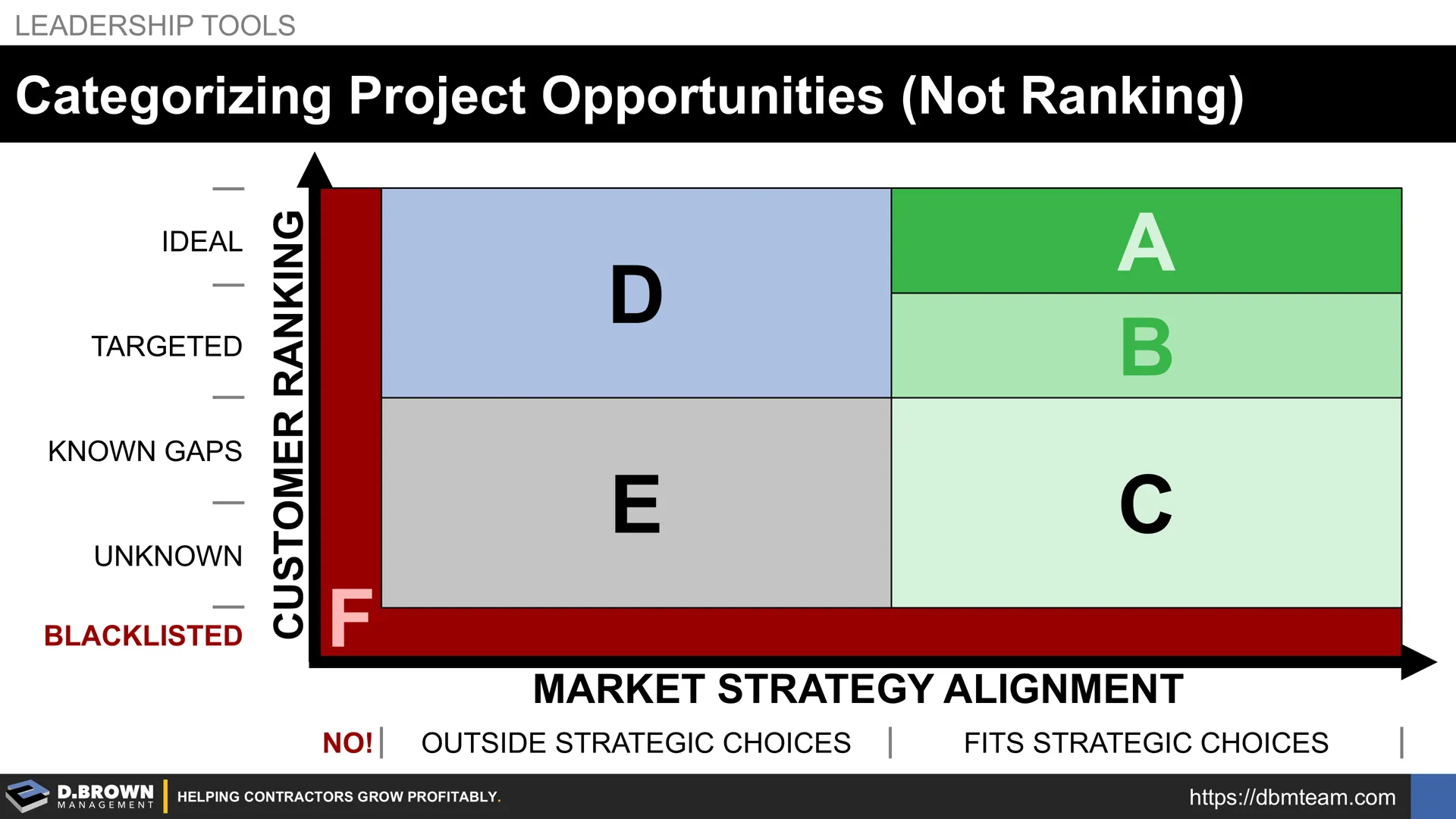
These categories are not the same as ranking for a Go/No-Go process. There are plenty of situations where you may choose to pursue a category D or E opportunity over an A, B, or C opportunity. That will be explained more below including examples.
Two Dimensions - Customer & Strategy
There are two main dimensions to this categorization:
Customer: Once a contractor gets out of initial startup and survival mode, one of the first strategic decisions should be defining what their "Ideal Customer" looks like and creating a list of customers who fit that definition. At the other end of the spectrum are "Blacklisted" customers - those you would rather starve than work with. The final list consists of "Targeted Customers" - those you believe have a high probability of fitting your ideal customer criteria and are receiving focused pursuit efforts.
Strategic Market Choices and Experiments: These define where you are placing your bets, including industry sectors, geography, scopes of work, and delivery methods. At the other end of the spectrum are "Never-Go" boundaries that define where you will not compete, including geographic limitations, project size limitations (high or low), and similar constraints.
The Categories
A. Ideal Customer + Strategically Aligned Project Opportunity
B. Targeted Customer + Strategically Aligned
C. Other Non-Blacklisted Customer + Strategically Aligned
D. Ideal or Targeted Customer + Other Project Opportunity Not Strategically Aligned
E. All Other Opportunities Not Category F (Below)
F. Blacklisted Customers or Never-Go Project Boundaries
Clarity Drives Scalability
You should be able to lay out your criteria in writing (a few pages at most) clearly enough that anyone with reasonable industry knowledge can categorize an opportunity with about 90% accuracy. This level of clarity does not create constraints, it creates scalability. Achieving that clarity is one of the harder things to do, especially for a founder, because they are evaluating so many criteria simultaneously. The problem is that approach does not scale and often creates an entrepreneurial trap.
The lists of customers (ideal, targeted, and blacklisted) are absolutes defined at a certain tier of management. These may change over time but are not flexible in the moment.
The specifics for strategic market choices including never-go must also be equally clear.
If you can't describe what you are doing as a process, you don't know what you are doing.
Clarity Must Be Enabling; Not Stifling
The clarity around this categorization, measurement, and feedback loop will enable better decisions when managed correctly. If you find that it is turning into stifling bureaucracy, that is more about how it is being managed than a problem with principles being laid out.
This clarity helps for a few reasons, including:
Prioritizing business development resources toward targeted potential customers.
Learning who the players are in a new industry sector or geography if that is part of your choices.
Adjusting your criteria for ideal customers if you are seeing (or not seeing) this correlate with project outcomes from pursuit through project exit. Look for patterns, not one-off experiences before making adjustments.
Adjusting your strategic choices and experiments as you watch the deal flow (opportunity pipeline) and project outcomes for category D and E opportunities.
You may have market choices that were in categories A, B, and C three years ago, and are now in categories D and E today.
Like any other plan or budget, the clarity gives you the foundation to build from.
A+B Opportunity Pipeline
Based on your target pipeline size math, your first big milestone for business development and management is to comfortably meet or exceed that size with just your A+B opportunities. That is where you prove out the viability of your strategy, business model, and management systems.
This is a high but achievable bar. We have never had a client who achieved this and didn't have great outcomes on all measures of success, including scalability and succession.
It is important not to rationalize your way into this. Again, criteria must be very clear, in writing, and infrequently changed only by leadership.
Examples of Nuances
There are a lot of nuances that go into whether something moves forward through the Go/No-Go process or not. Again, this does not change the category. A few common examples of nuances:
You are working to get your foot in the door with a targeted customer. They have asked you to bid on a project that falls outside your strategic market choices but is not in the "Never Go" zone. Sometimes, pursuing this opportunity is absolutely the right path to begin building a relationship. Other times, it is better to politely pass. This decision should be made by leadership as part of an intentional customer strategy. As a result, a category D opportunity may occasionally take priority over category A, B, or C opportunities.
You come across an opportunity that looks interesting. It is outside your current strategic choices but meets many of your other criteria. After meeting with the project owner, you realize they fit many of your "Ideal Customer" criteria. This still makes it a category E opportunity, but it may be pursued based on leadership judgment and resource availability. Caution: Before letting this influence future strategic choices, make sure you are not rationalizing the decision because you lack enough opportunities in the pipeline that fit your current strategy.
You come across a project that is double your maximum project size criteria. However, it is with one of your best customers, includes favorable payment terms, and is phased to keep peak staffing requirements within your proven capacity. Depending on your "Never Go" criteria, this may initially be categorized as an F opportunity. Even so, leadership may decide to pursue it based on the specific circumstances. The categorization does not change; only the decision to pursue it changes.
These are just a few examples of why you want your team, including business developers, constantly exploring opportunities. A good rule of thumb is that, of the relationships and opportunities they bring to the table:
80% should comfortably fit within your strategic and customer choices.
10% should require corrective feedback to help them understand the strategic and customer choices.
10% should be a "Smart Stretch" that make you pause and reflect like some of the nuances identified above.
These aren't hard and fast metrics but...
If too high of a percentage requires corrective feedback, then either you haven't defined them with enough clarity, you've defined them too narrowly and there simply aren't enough opportunities that fit that criteria in the market, those working on business development aren't being disciplined, or a combination of all three.
If too low of a percentage isn't a "Smart Stretch" that makes you pause and reflect, then either those working on business development aren't being creative and aggressive enough, the manager of the process is being too rigid, or a combination of both.
Hopefully this gives you some food for thought.
How does your opportunity pipeline measure up?
How has it changed over the last couple years?
Is it delivering the business results you are expecting?