Contractor Exit Strategy 6 of 6: Sale to Employees (ESOP)

Contractor Exit Strategy 6 of 6: An ESOP (Employee Stock Ownership Plan) is a qualified defined contribution employee benefit plan designed primarily to invest in the company’s stock.

D. Brown Management Profile Picture
Share

This is a more complex and costly structure to set up and maintain but also comes with some tax advantages. And while these costs and savings are easy to model, they should not be your deciding factor in whether a ESOP should be all or part of your exit strategy.
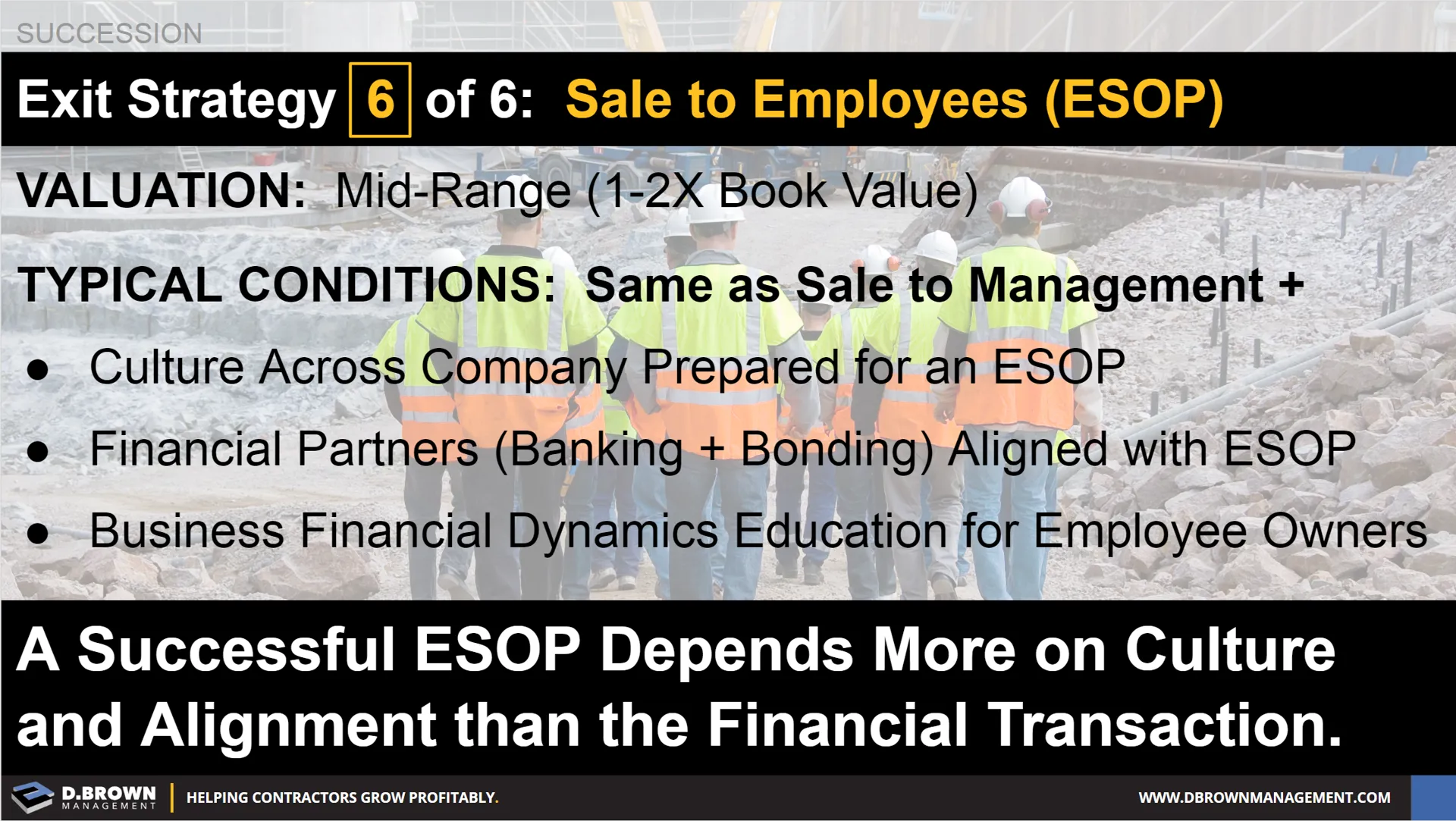
Succession: Exit Strategy 6 of 6 - Sale to Employees (ESOP).

For starters, this exit strategy should be weighed against a sale to management because all the same prerequisites have to be met, including having strong leadership, an aligned management team, and a business that is continually generating excess cash flow for funding of the deal.  

The big initial questions to really dig into:

  • Will broader employee ownership make the business operate better than having a smaller group of managing owners who carry more of the risk but also have more to gain?
  • Is the culture truly prepared for an ESOP? In a leveraged ESOP, often other contributions to retirement programs and bonuses are cut back which can demoralize a team without the proper education.
  • Will your bank and surety be onboard with an ESOP?

Resources:


Contractor Exit Strategy 6 of 6: Sale to Employees (ESOP)
Continue building value in your business, yourself and your key team members with a good succession strategy....

Contractor Exit Strategy 6 of 6: Sale to Employees (ESOP)
Continue building value in your business, yourself and your key team members with a good succession strategy....

Cash Flow Tip 12 - Rapid Close-Out = Good Cash Flow
If you effectively manage the startup and the close-out of the project, then the execution in-between mostly takes care of itself.
Four Levels of Integration and Optimization
Operational excellence must be a major component of every contractor’s strategy and baked into their daily behaviors. Optimizing at each of the four major layers requires different levels of thinking, technology, and time span.
Opportunity Evaluation (2 Critical Dimensions)
Your strategic decisions show up most vividly in the opportunities you choose to pursue. Disciplined and aggressive business development will ensure a strong pipeline of opportunities. Choosing what to pursue requires balancing two critical dimensions.