
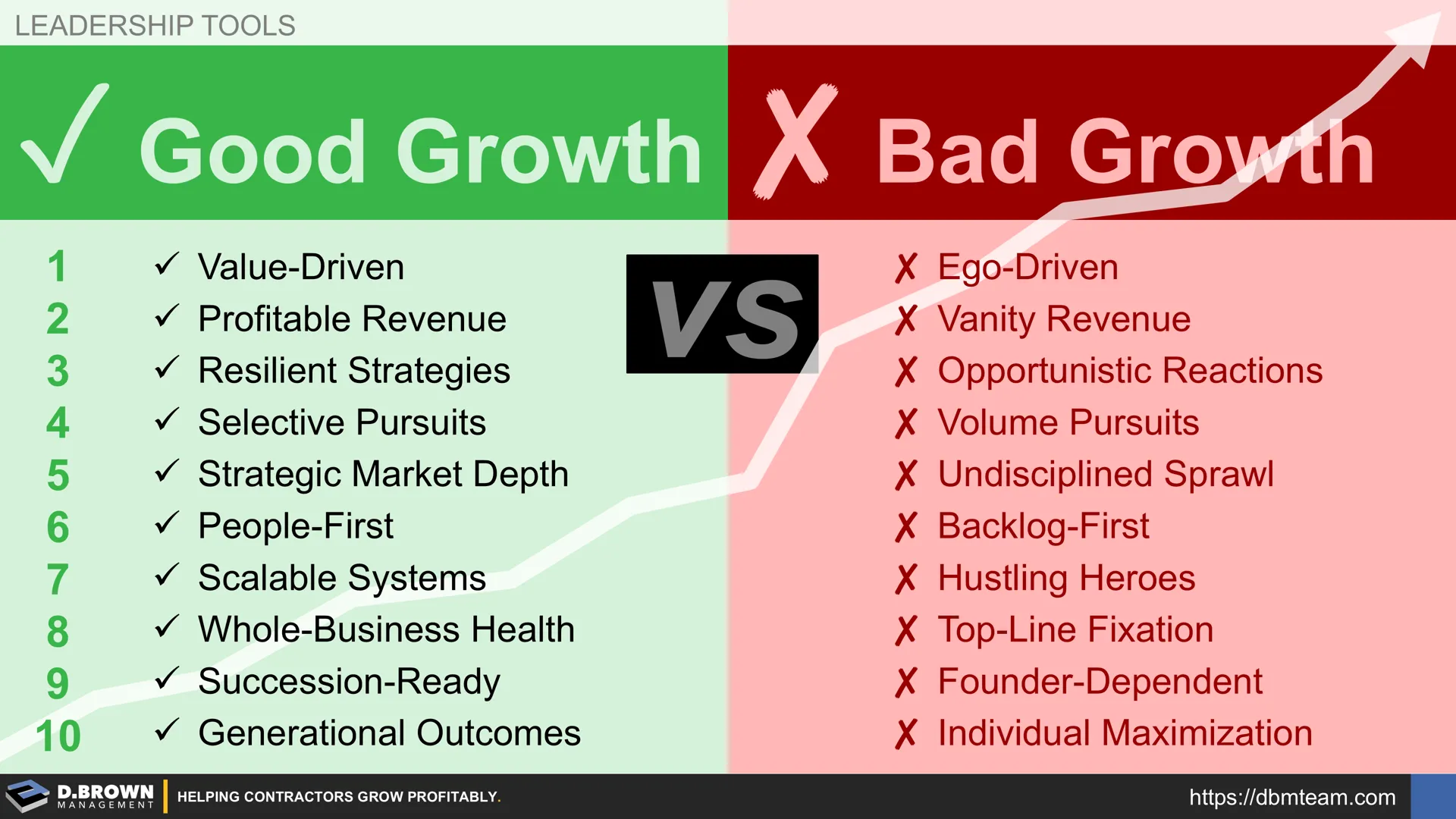
Ten Nuanced Differences Between Good and Bad Growth
1. Value-Driven vs. Ego-Driven
2. Profitable Revenue vs. Vanity Revenue
3. Resilient Strategies vs. Opportunistic Reactions
4. Selective Pursuits vs. Volume Pursuits
5. Strategic Market Depth vs. Undisciplined Sprawl
6. People-First vs. Backlog-First
7. Scalable Systems vs. Hustling Heroes
8. Whole-Business Health vs. Top-Line Fixation
9. Succession-Ready vs. Founder-Dependent
10. Generational Outcomes vs. Individual Maximization
Diving a Bit Deeper into the Nuances
Value-driven growth is focused on creating real value for all stakeholders, not simply creating transactional value. This value creation includes the extended Project Value Stream (PVS) through to everyone on the team - the Talent Value Stream (TVS). Ego is not bad if used to create real value rather than transactional value - for instance, the ego driving two apprentices to "compete" for the most production in a day on their paths to mastering their craft, then enjoying a debrief with their crew leader at the end of the day learning from each other. Most people know what "bad ego" looks like so there is no need to discuss that any further, and if you don't know the difference, no amount of explanation will matter.
Profitable revenue with good cash flow is a prerequisite for viability and sustainability. We often talk about a contracting business in terms of revenue and headcount but those are never without context of quality. There are very, very few conditions when knowingly taking on unprofitable revenue is the right strategic choice. Most of the time, unprofitable revenue is unknowingly taken on due to a contractor underestimating the scope of the work as compared to their capabilities and/or capacity, not knowing their true costs, or inaccurate quantity and cost estimating. The worst is when ego to be the biggest comes into play driving vanity revenue - this is definitely one of many "bad ego" examples. We typically target 2X industry benchmark for our definition of profitable revenue. Look back over the last three years - what are your trends with safety, customer satisfaction, profitability, cash flow, and growth?
Resilient strategies at all levels ensure a contractor will grow faster than their peers in all economic conditions when measured over the long haul. It is easy to react opportunistically to high-growth markets. It is much harder to be disciplined in your strategic choices focusing on the fundamentals that won't change. Resilient strategic choices are good for shareholders, employees, customers, suppliers, and the community. Note that resilient choices may seem counter to efficient choices in the short-term. A great example was the global supply chain which has been increasing in complexity driving toward ultimate economic efficiency. Taken too far, efficiency becomes fragility and complex dependencies create unknown risks. We experienced both during COVID.
Selective pursuits around markets, customers, and projects are one of the first places strategic choices and leadership discipline show up. This is completely different than pursuing volume either for vanity or simply due to a lack of options in the opportunity pipeline. Study the last twelve months of all the opportunities you knew about, pursued, and won. How would you answer these ten questions about winning work?
Resilient strategies and selective pursuits build strategic market depth, and that becomes an incredible flywheel for growth. Within those geography(s), industry sector(s), and customers you have built strong capabilities, relationships, and reputation. This leads to more opportunities which gives your team more cycles to practice which builds better capabilities, and the flywheel continues to spin. On the other hand, undisciplined sprawl means that every pursuit and project is a struggle, and many times a race to the bottom with pricing as the only differentiator.
People-first is a the only sustainable way to think about a construction business, family, or community. Every person deserves to work in an environment where they can continue to learn and grow wealthy by all measures, and through all seasons of life. As described earlier, profitable revenue and cash flow must be there to make the required investments in people. Strategies around project delivery methods including CM-at-Risk can help building good backlog and talent at the same time. Focusing on backlog-first and hoping to find new people or just stretch the existing team never ends well. Sustainable growth happens when organizational strength is building just ahead of revenue.
Scalable management systems, governance structures, and enabling organizational hierarchies are the foundation to sustainable growth and must evolve with growth. Every project and construction business will require heroic efforts at times - but those must be the rare exception. Those exceptions must either be true black swan type of events or triggers to move standards to the next level aligned with growth. Contractors with full-time superheroes are never sustainable.
We all want holistic wealth for ourselves and those we love. Leading a construction business for long-term growth requires whole-business health rather than a myopic fixation on a single thing like top-line growth or short-term profits. Like your life, this requires optimization for the long-term rather than short-term efficiency in any single area.
Succession readiness at all levels is critical for sustained profitable growth. Founder-dependency dramatically increases stress while decreasing valuation during ownership transitions. The ideal visual model of a great succession is when a leading position is handed off smoothly and the person taking the baton increases that lead - just like Team USA setting a world record in the 2024 Olympics.
We exist to help contractors build stronger businesses for the next generation. The leaders we work with believe the same. While we are engaged by those leaders and spend most of our time with the leadership team, the reason why is for that person sitting in middle-school right now and just starting to think about a career and their class schedule for high-school. The reason why is for that person who just had their first day on a jobsite. This long-term focus on building people from their teens through their retirement masterpiece is what truly separates great leaders in the industry. We have never seen this generational focus result in the leader not being incredibly successful by all measures that matter including financial. On the other hand, we've seen plenty of people focused on individual maximization - and that rarely plays out well over a lifetime.
So, why growth? It's a complicated question. When asked, it often has a lot of emotion behind it. The question is usually asked when someone is in the middle of leading necessary changes which is never easy.
Hopefully these ten points gave you something to think about as you are navigating your own journey.
