
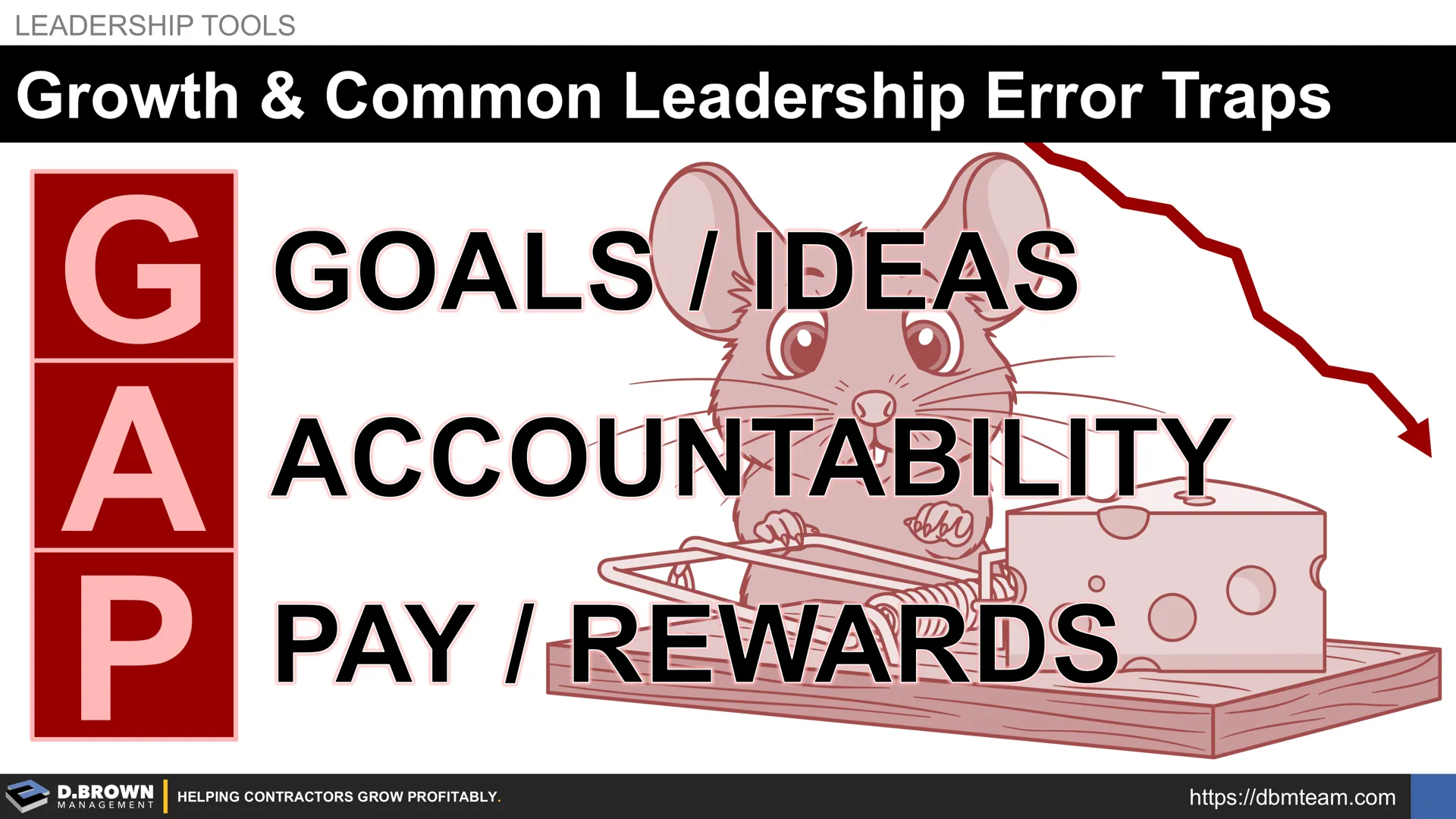
As contractors grow, the three biggest challenges we see in their leadership and management are:
Goals and Ideas
Accountability
Pay and Other Rewards
We can shorten these to the acronym of GAP - because that's what they are. On the surface, these may seem obvious, just difficult to execute. There will be no shortage of social media, podcasts, books, articles, etc. that shout very loudly about all of these.
These are obvious and must be part of every growing business. It is not the concept that is difficult, it is the thousand other details that must be aligned one by one over time that makes these challenging. It's a little like all the diet book fad titles that sell millions. Something like "Beach Body in 30 Days" only works for someone with all the prerequisites who is already close to the objective. And they really don't need the book. For 99% of everyone else, they will see a few results then likely fall short and buy another similar book next year.
Building an effective team starts with building your own leadership and management capabilities. That requires a lot of consistent practice and feedback over time.
GAP 1: Mistaking Goals and Ideas for Vision, Strategy, Systems, Structure, and Planning
Everything starts as a fuzzy picture in our brains when a couple neurons loosely make a connection. As those ideas take additional shape, it is pretty common to turn them into goals. The next level of development is turning those into S.M.A.R.T. (Specific, Measurable, Achievable, Responsible, and Time Bound) goals. Just getting to that point is difficult and a great development step for a management team. With that said...
Goals and ideas are less than 1% of the work required to consistently turn them into outcomes.
A collection of goals and ideas is not a compelling vision that will attract, align, motivate, and retain people over the long-term. What is your vision - your winning aspiration? What does it look like when you are there?
A collection of goals and ideas is not the same as an integrated strategy that positions you in the best place to win. Where will you play? Where won't you play?
Most of the "Strategic Plans" we see from contractors and many facilitators are what we consider the first phase of the process. If that is a development step, no problem. It will often take a team 5-10 years to truly build all six phases into a routine structure. The most dangerous thing in leadership is to think you have a winning strategy and actionable plan when you just have a collection of goals and ideas organized in bullet points.
Once you have developed your market strategies, those must be integrated throughout operations.
Those strategies must be turned into business plans and management systems supported by an organizational structure that will ensure they get executed.
Like a project plan, business plans must be more than a list of goals. Even after those goals are integrated with the strategy, they must be scheduled based on prioritization and sequencing.
Scoreboards and scorecards around these goals are critical tools but will range from ineffective to counterproductive if not managed right.
GAP 2: Accountability Alone is Nearly Always Counterproductive
"We just need to hold people accountable" is a phrase we hear frequently with emerging management teams. With solid management teams, it is rarely talked about in a sentence. It is just part of a comprehensive management system from the Board of Directors (if applicable) and CEO through the new apprentice just starting.
Patrick Lencioni describes accountability as the top of a functional team pyramid model with trust as the foundation.
Accountability without clarity, capability, and capacity will only create stress, not results.
GAP 3: Pay and Other Rewards will Drive Results
Compensation and other rewards must be there to reward results in alignment with the market. Anyone outside market ranges by more than 10-15% likely won't stay, won't pencil out as part of your business model, or likely won't join your team. Compensation systems will always increase in complexity as a contractor grows.
Like accountability, there are a lot of myths and realities around compensation.
Effective systems have a far greater impact on achieving an outcome (hitting a target) than compensation systems.
Compensation must align with responsibilities and business results in the longer-term, but total cost including training and management is nearly always out of alignment in the shorter term while there are learning curves.
Compensation will not increase capacity beyond a little overtime incentive. We are all very familiar with how fast physical productivity, quality, and safety drops off past 5-day, 40-hour weeks in the field. That drop off is even faster for knowledge work.
"A system is not the sum of its parts; it is the product of their interactions." - Russell Ackoff
In summary, it's not that goals, ideas, accountability, pay, and other rewards are not important. It is just that they represent very few parts in a complex system for a 150-person contractor.
The common leadership and management gap is not seeing all those other parts and their interactions -- and then seeing how those parts and their interactions change at 500-people, at 1,500, and beyond.
