
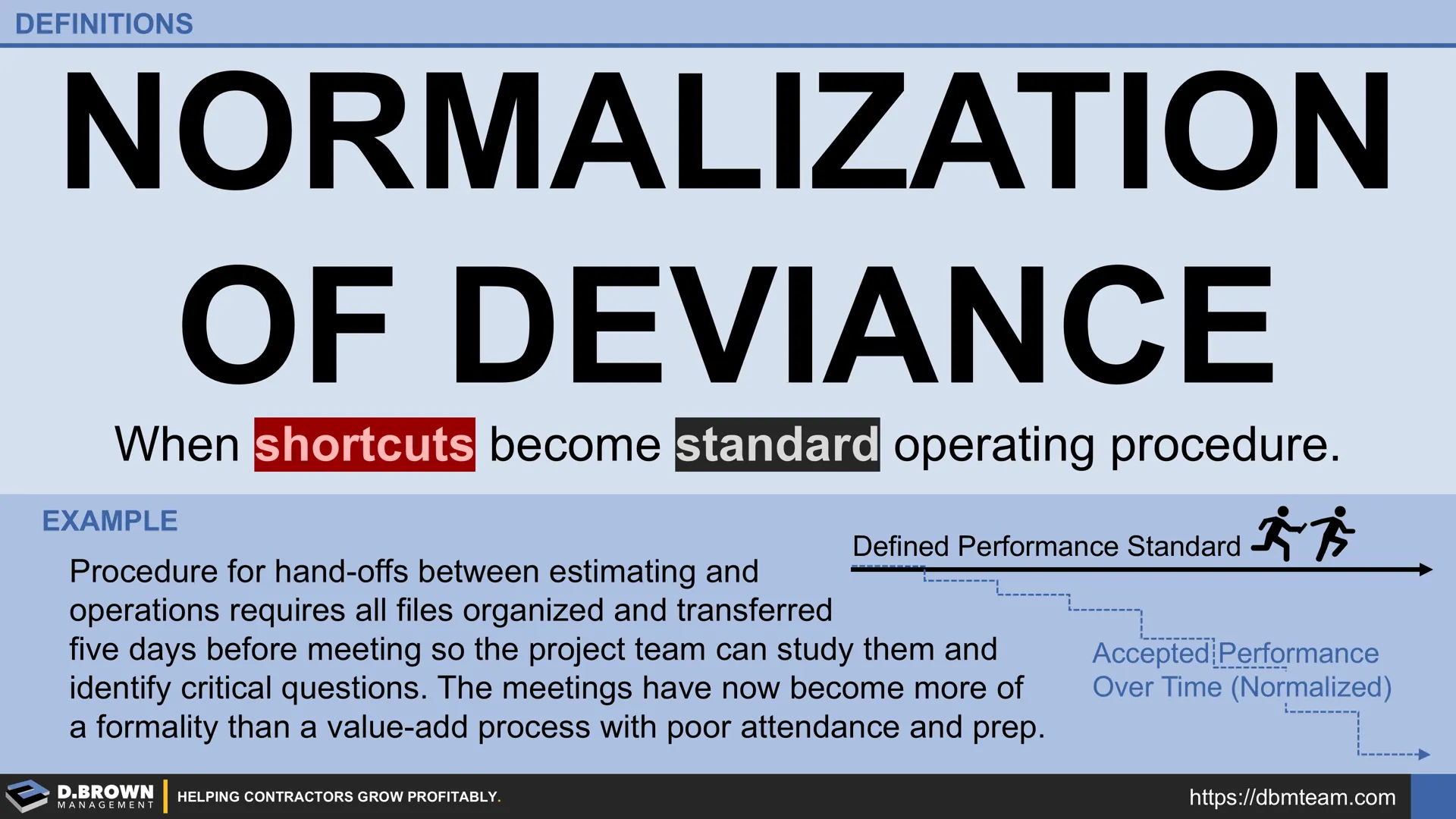
EXAMPLE: Project Hand-Off
The Award-to-Start process is one of the most important phases within the Project Value Stream (PVS). Setting standards for this process, following those standards consistently, and continually improving with each project award is often one of the highest impact areas for leaders to focus on.
A common example of “normalization of deviance” starts with the hand-off meeting that nearly every contractor has between award of the construction scope and turnover to the project teams who will build the project. It may be called different things by different contractors, but the general flow is similar. The ideal hand-off looks like a great baton pass in an Olympic relay.
It is relatively common to have clear standards around this process, including how quickly the notification of award should go out to the project team (ASAP), what information needs to move from precon/estimating to the project team, and what is expected to occur during that first meeting, starting with preparation.
It is also common for these standards to slip. Notices go out late. Files aren’t organized or transferred on time. The meeting gets scheduled at the last minute, causing poor preparation and attendance. Those small slips turn the meeting into a formality instead of a value-add discussion on scope, commitments, estimating assumptions, and key risks and opportunities.
Once discipline on that initial process breaks down, it becomes nearly impossible for even the best project team to stay proactive. This turns project managers into project observers and superintendents into firefighters, with senior management responding to negative customer escalations.

The Essential Deming (Audible)
EXAMPLE: Tying Your Boots
John Wooden has one of the best coaching records of all time. And like many great coaches, he started with the basics like putting on your socks and tying your shoes with extreme attention to detail. As insignificant as this sounds, think about how many injuries are caused by this simple lack of attention to detail.
No one ever expects to step out of their truck first thing in the morning and hit a rut or rock just wrong enough to sprain or break an ankle.
- The statistics show that you could step out of that truck 1,000 times or more and never have that happen, even if you aren't wearing work boots at all.
- Statistics also show that having supportive work boots on, laced and tied correctly, won't prevent that injury every time.
- Psychology also shows that discipline in small habits tend to show up in many other areas such as the organization information, materials, and tools leading to more productive, higher quality, and safer installations. Charles Duhigg discusses these "Keystone Habits" in The Power of Habit.
- Studies of leadership and parenting shows that people don't often listen but definitely imitate. From that experienced journeyman to crew leader and above, everyone is watching. You must be a visible role model for the behaviors you expect in the organization. Culture is defined by the worst behavior knowingly tolerated by leaders.
Discipline is not micro-management although it can feel like it in the early stages of learning. Discipline in these seemingly little things is what builds capabilities and scalability. The breaking down of discipline in these seemingly little things often introduces more catastrophic risk as shown in the next example.
3-Minute video from one of John Wooden's players
EXAMPLE: The Challenger (1986) and Columbia (2003)
Mike Mullane is a retired astronaut, and engineer. He provides a great overview of the Challenger and Columbia space shuttle disasters demonstrating both normalization of deviance and organizational memory fading between generations of leadership. There are lessons to learn here from construction safety through effective leadership succession.
EXAMPLE: USMC Leadership Dichotomy 1/8" Uniform Standards and Subversive Behavior
The opposite of “normalization of deviance” is not rigid adherence to a prescriptive standard. The videos below show this through the “why” behind the 1/8" Marine Corps uniform standard and the structured training on subversive behavior that is sometimes required to get results. Leadership is about balancing the dichotomy between these two ends of the spectrum.
General Eric M. Smith (90 seconds starting at 52:37)
Charles Duhigg / Smarter Faster Better / Marine Boot Camp Revamp (5 Minutes)
Building a bias toward action and internal locus of control
REFLECTION QUESTIONS
- What are a few areas on your life where deviation from your standards has dropped over time and become normalized? That could be quality of time with kids, quality of time with partner, quality of time with yourself, diet, exercise, etc. Don't think about others - just about yourself.
- What are a few areas of your life where perhaps you have become too rigid in adherence to a standard that is negatively impacting your progress toward a goal including holistic wealth. These could be similar to the categories above. Too much of a good thing can become bad. This may be the need for too much perfection in planning. It could be something else. The self-reflection is important for the next questions.
- Study your organizational charts, values, strategic choices, standards, business model, management systems, and business plans. Walk your shop and jobsites.
- What are a few areas where “normalization of deviance” is negatively impacting outcomes or introducing risk? Please include specific examples with people, projects, timelines, quantification, trends, and frequency of occurrence where applicable.
- What are a few areas where you are being too rigid and impacting continuous improvement, innovation, or talent development?
Pro Tip: Have several people on a team do this exercise independently putting their answers into writing to clarify thinking. Come together and discuss the answers looking for similarities and differences then decide on next steps.
