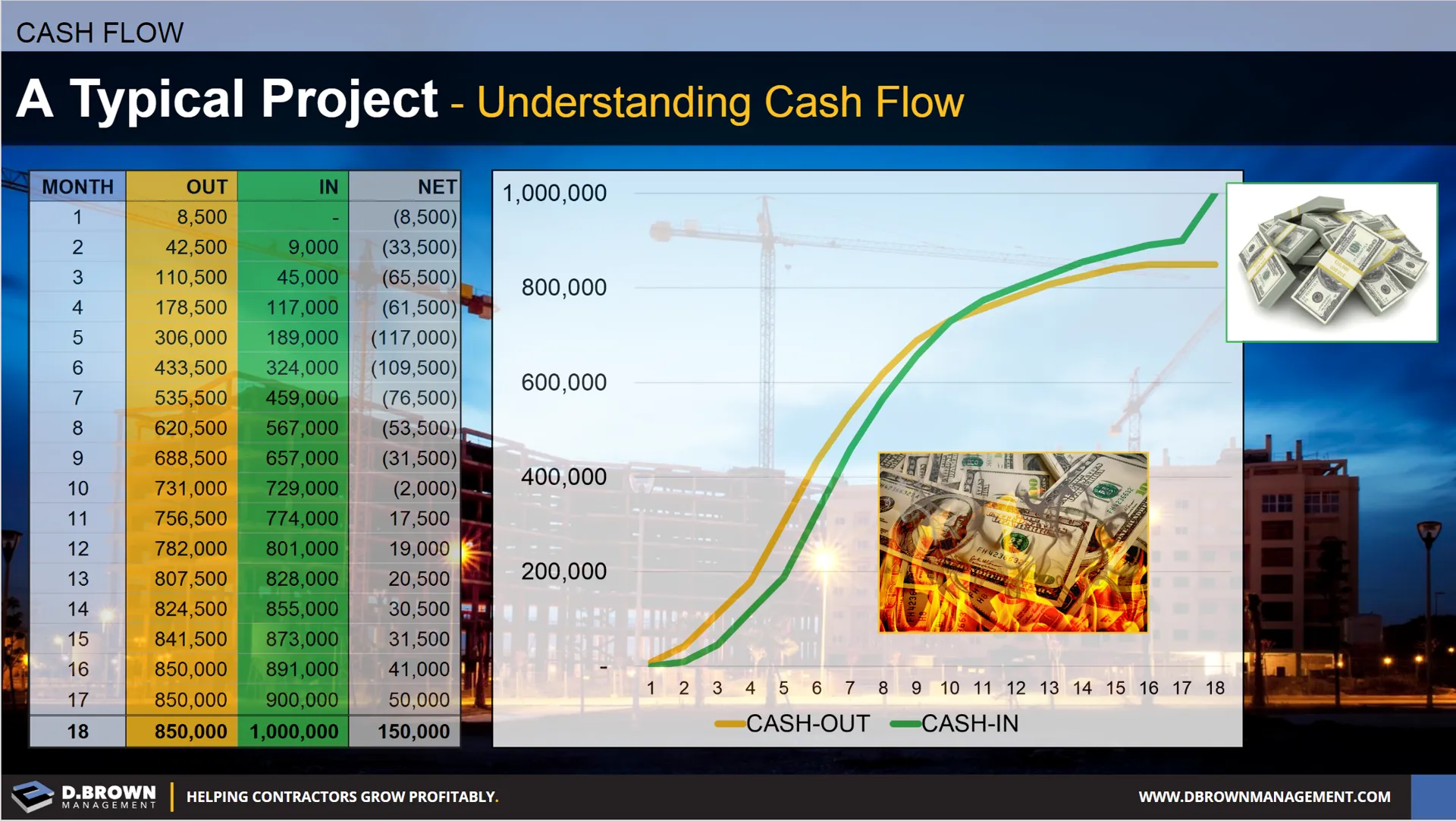
A Typical Project - Cash Flow S-Curve

Ensuring great financial outcomes is the ONLY way to build a sustainable construction business that can serve customers and develop team members over the long-term.

D. Brown Management Profile Picture
Share
Cash Flow: A Typical Project - Understanding Cash Flow

A project team has seven basic objectives and those tie into the contractor’s high-level scoreboard.

The basics:

This S-Curve chart shows just the cumulative cash flows in and out at the project level.  Overhead is excluded from this calculation for simplicity. The numbers are all based of the monthly data.

As you can see it is not until month 11 that the project becomes cash flow positive and that is without covering any overhead!  

Look at what happens when you factor in overhead

We are revamping our publicly available cash flow workshop that includes 18 techniques that contractors can use to accelerate cash flow. Stay informed of updates on release.


A Typical Project - Cash Flow S-Curve
Great cash flow is a key driver of valuation and successful successions. Running out of cash is is the #1 reason contractors fail. Improving cash flow improves your Return on Equity. Protect yourself and never let cash flow be the limitation to your profitable growth....

A Typical Project - Cash Flow S-Curve
Great cash flow is a key driver of valuation and successful successions. Running out of cash is is the #1 reason contractors fail. Improving cash flow improves your Return on Equity. Protect yourself and never let cash flow be the limitation to your profitable growth....

Seeing the Mountain - Levels of Detail
You will find a clear path to the top of the mountain faster as you build your ability to situationally vary the resolution you see the world in. This applies to the construction of a project, the building of a contracting business and to life in general.
Strategic Market Experiments
A growing contractor must systematically allocate 10-20% of their resources, including talent and capital to Strategic Market Experiments that have a probability of growing into a major market and becoming a "Strategic Choice."
Required Leadership Focus Changes at Each Stage of Growth
At each stage of growth, the leadership focus at the top for majority Owners/CEO/President must change to continue navigating growth effectively. Concurrently, the leadership focus from the prior stage of growth must be transferred and expanded downward.