
A craftsperson physically installing material or making a repair always happens in the moment. This is where the majority of time and money is spent in construction. Transforming a concept into something physical is the foundation of construction and will never change. Operational execution happens in the moment including the problems that need to be solved. Nearly everything that occurs falls into what Stephen Covey describes as quadrant 1 priorities that are both urgent and important. That is the pace, joy, and challenge of operational execution.
With that said, building a project and building a construction business requires work that supports operational execution. This work occurs at different time horizons starting with the Foreman building, communicating, then managing a weekly and daily plan. This is the first place you see time horizons begin to separate and extend further out.
As a contractor continues to grow, the functions become more specialized, and the time horizons extend further. One of the many challenges of growth is keeping the entire team and extended external team integrated across the specialized functions and differing time horizons.
We are going to go through a few examples that a contractor in the 150-500 peak headcount range would likely be working through:
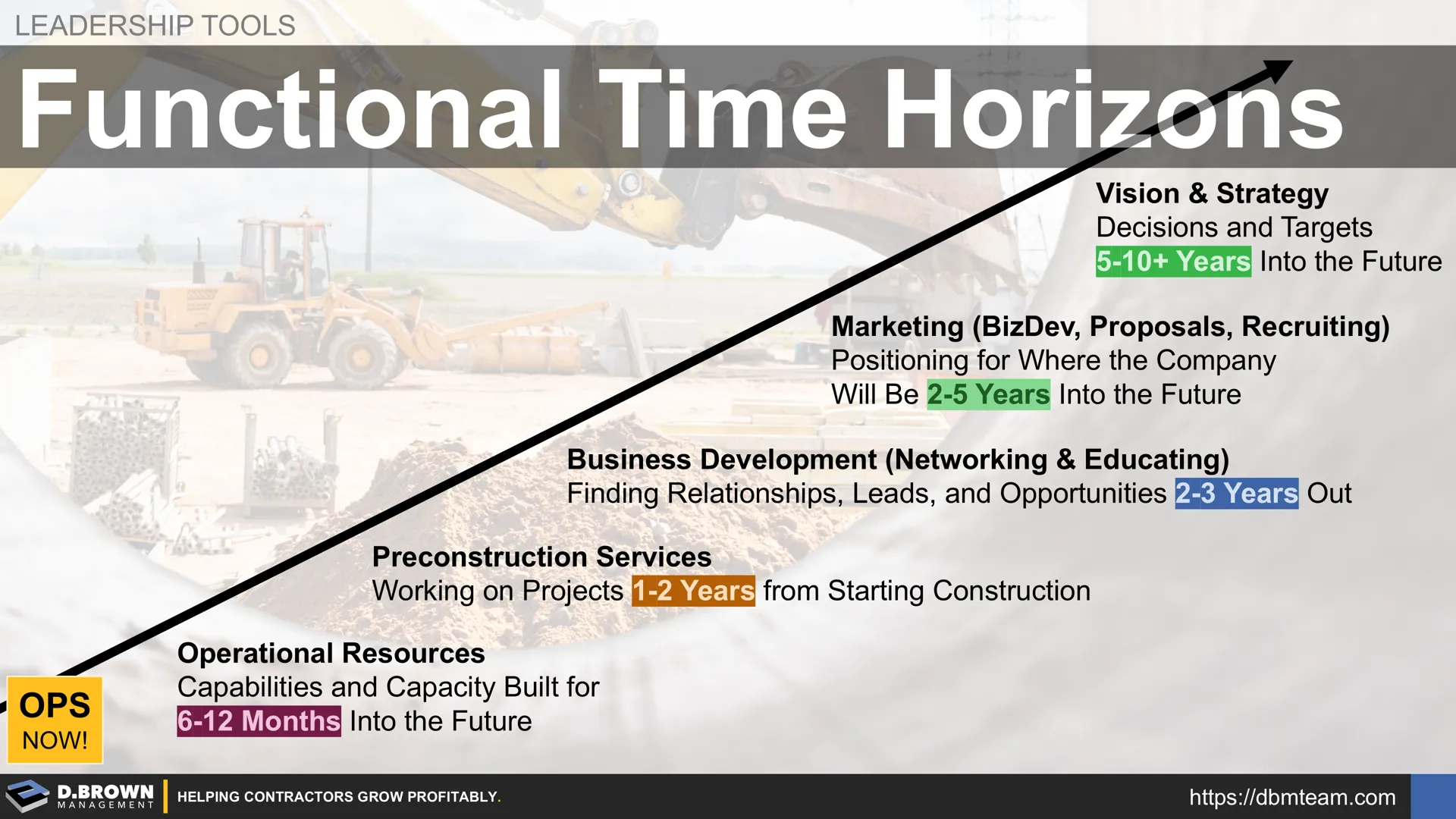
Operational Execution: As described above, this is always happening now.
Operational Resources: When starting up, capabilities and capacity are built just-in-time for operational execution needs. Often, they are built just a little behind, so you always feel like you are catching up and juggling. With growth, you start to build these resources including people, equipment, and capital 6-12 months in advance. This may include buying a piece of equipment or hiring a Project Manager in the fall to prepare for work you expect to have the following spring.
Preconstruction Services: As contractors grow, they will tend to be involved in and be awarded projects at earlier and earlier stages of design development. By delivering value earlier through advanced preconstruction services, a contractor will be awarded projects well before construction begins, often 1-2 years ahead. This is a flywheel that makes investing in operational resources earlier less risky with returns nearly guaranteed.
Business Development: The process of gathering information about the market like a scout in the military, educating the market about the contractor's capabilities like a professor, and networking to build relationship connections that will lead to project opportunities. One of the four truths about business development is that there are nearly always a lot more opportunities in the market than most contractors realize. Just knowing about these relationships and opportunities is the fifth of the nine business development hurdles - how many of these hurdles has your company passed? Business development is typically working on things that are 2-3 years out from construction start (operational execution).
Marketing: Atul Micocha makes a great distinction between "Little-M Marketing" basics like graphic design and highly focused, strategically aligned "Big-M Marketing" that supports business development, recruitment, and the selling of work through SOQ and REP responses. This level of marketing is positioning the contractor 2-5 years into the future and includes internal communications.
Vision & Strategy: These interlinked decisions made at every level of the company provide guidance from today to 5-10+ years into the future.
Integrating all these time horizons together are management systems from weekly project rhythms to 3-year business planning cycles with annual goals, quarterly updates, and monthly touch points.
These are just examples and not meant to be comprehensive or prescriptive. These are the most common points we see contractors struggling with as they are navigating from stage 4 to 5 of their growth. Some additional resources to help include:
