Profitability Trends

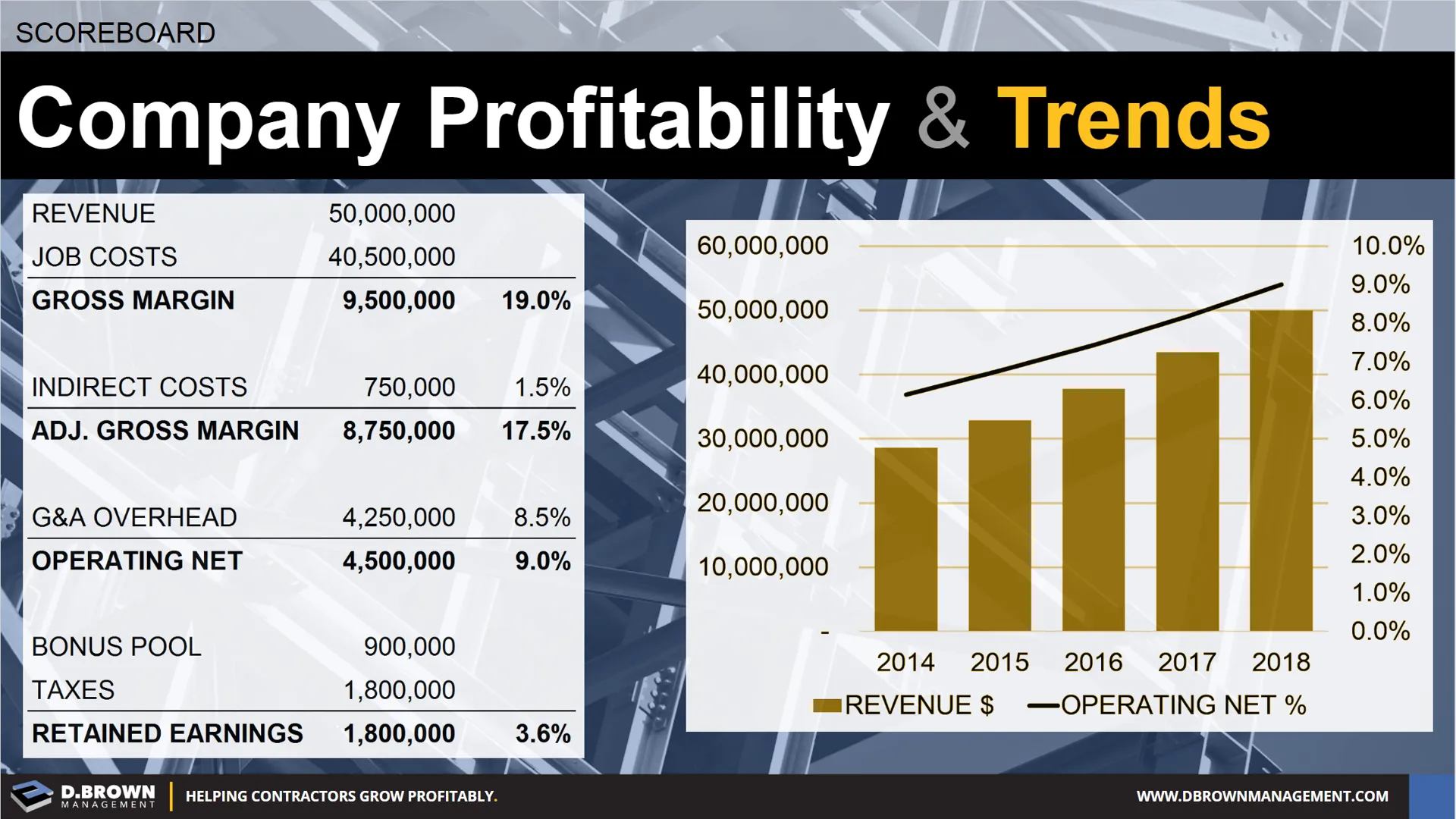
When you are looking at your scoreboard, remember that industry average benchmarks and single points in time only tell part of the story.
D. Brown Management Profile Picture
Share

When you are looking at your scoreboard, remember that industry average benchmarks and single points in time only tell part of the story.

Scoreboard: Invoice and Graph representing Company Profitability and Trends.

Just like physical training, what really matters for your personal health is that you are consistently improving.

  • Graph your key metrics over the last five years and look for relationships.
      
  • Analyze your data and look for outliers to help the trends make more sense. For example, did you have one super good or bad job in a year that completely skewed the metrics?

  • Be cautious not to over-rationalize “outliers.” If you have a bad job every year, remember that is more likely to be part of the trend rather than due to an outlier. For example, Motorola had something like 24 consecutive quarters of “one-time” expenses. If they occur that consistently, they are regular expenses and not one-time expenses. Also, Motorola is no longer around. 
     
  • What do those metric trends look like if you project them another 2-3 years into the future?

  • Which metrics are trending in the right direction?  

  • Which metrics can you improve?  How?  


Want to talk about it? Contact us for a conversation.


Required Leadership Focus Changes at Each Stage of Growth
At each stage of growth, the leadership focus at the top for majority Owners/CEO/President must change to continue navigating growth effectively. Concurrently, the leadership focus from the prior stage of growth must be transferred and expanded downward.
Can't Read the Label From Inside the Jar
By definition it is impossible for any of us to know what we don’t know. Who are the top 5 people inside your organization that help each other refine your models of projects, your company and the industry?
Talent Development Quote - Jack Welch
From 1981 through 2001 under CEO Jack Welch, GE’s market cap (value) grew 18% compounded annually from $14B to $410B. A large part of this profitable growth was due to the rigor placed on their talent development processes directly from the CEO.