Production Tracking - The Basics

The heart of any production measurement is simply “Earned Budget vs. Actual Cost”.

D. Brown Management Profile Picture
Share
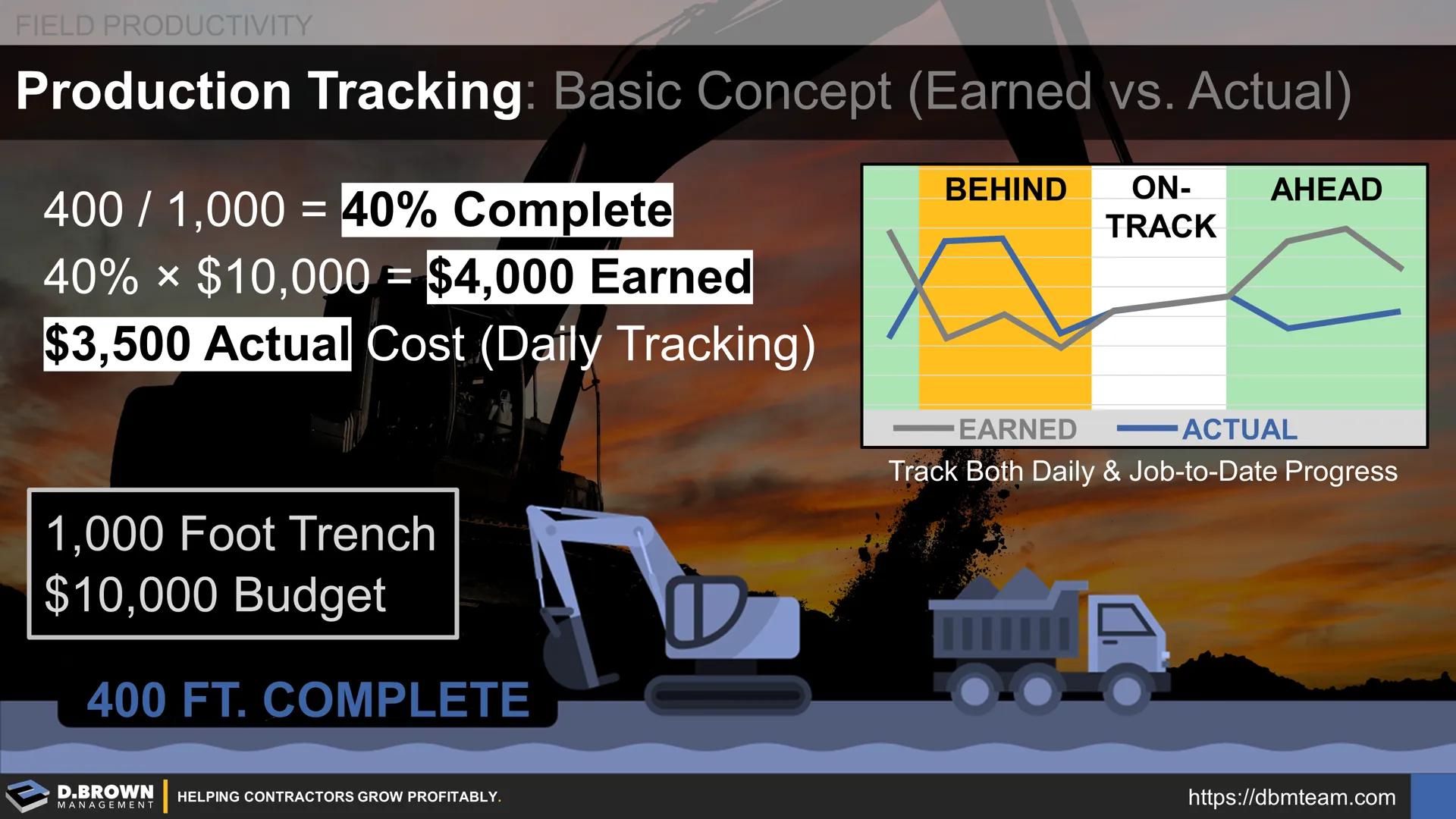
Field Productivity: Basic concept of production tracking. From budget to tracking of earned budget vs actual costs. Track Daily and Job-to-Date Progress.
  • Imagine a trench that is 1,000 feet long (task)on a project with a $10,000 budget.  
  • When it is 400 feet complete, it is 40% done. Therefore, the “Earned Budget” is $4,000.  
  • Looking at the daily costs in the field so far, if you have spent $3,500 you are ahead on your production at this stage.  
  • If you had spent $4,500, you would be behind on your production. 

Your actual costs don’t have to be perfect while you wait for them to get to the accounting system and back to you. This is about general directionality and it is better to have immediate feedback so you can take corrective action rather than wait for days or a week plus for more exact information.

Schedule + Production are two foundational key results the Foreman will achieve through their planning. This is all supported by the rest of the project team’s objectives and planning process

Schedule control is about doing what you say when you say you will do it. 

Production control is about minimizing the cost of delivering each task by minimizing every step that does not directly add value.

A Foreman can use production tracking as part of their ABC Daily Planning and continuous improvement.   


Improving Labor Productivity Workshop


Production Tracking - The Basics
Field labor is the often the biggest variable on a construction project - making it the biggest risk and opportunity....

Related Training
Production Tracking - The Basics
Field labor is the often the biggest variable on a construction project - making it the biggest risk and opportunity....

Change Management Dashboards
Summarize your detailed change tracking logs with concise dashboards that give you critical information in a format that allows you to see the big picture while still having enough information to be actionable.
Creating The "Perfect Field Day"
Contractors build things and that comes down to the men and women in the field. They are the ones adding the value to the raw materials and that is ultimately what the customer is paying for.
Field Productivity - The Improvement Pyramid
An improvement of a few minutes per day to actual installation time compounded monthly is worth about $800K per year for a $25M contractor. What is it worth to you? Improvements to field productivity can be viewed as 4 major stages of a pyramid.