Project Delivery - Design-Build

In the Design-Build method the project owner has a single contract with the general contractor who then has contracts with the architect and trade contractors.

D. Brown Management Profile Picture
Share

The Design-Build method of project delivery eliminates a couple of the major negatives inherent in the Design-Bid-Build method.
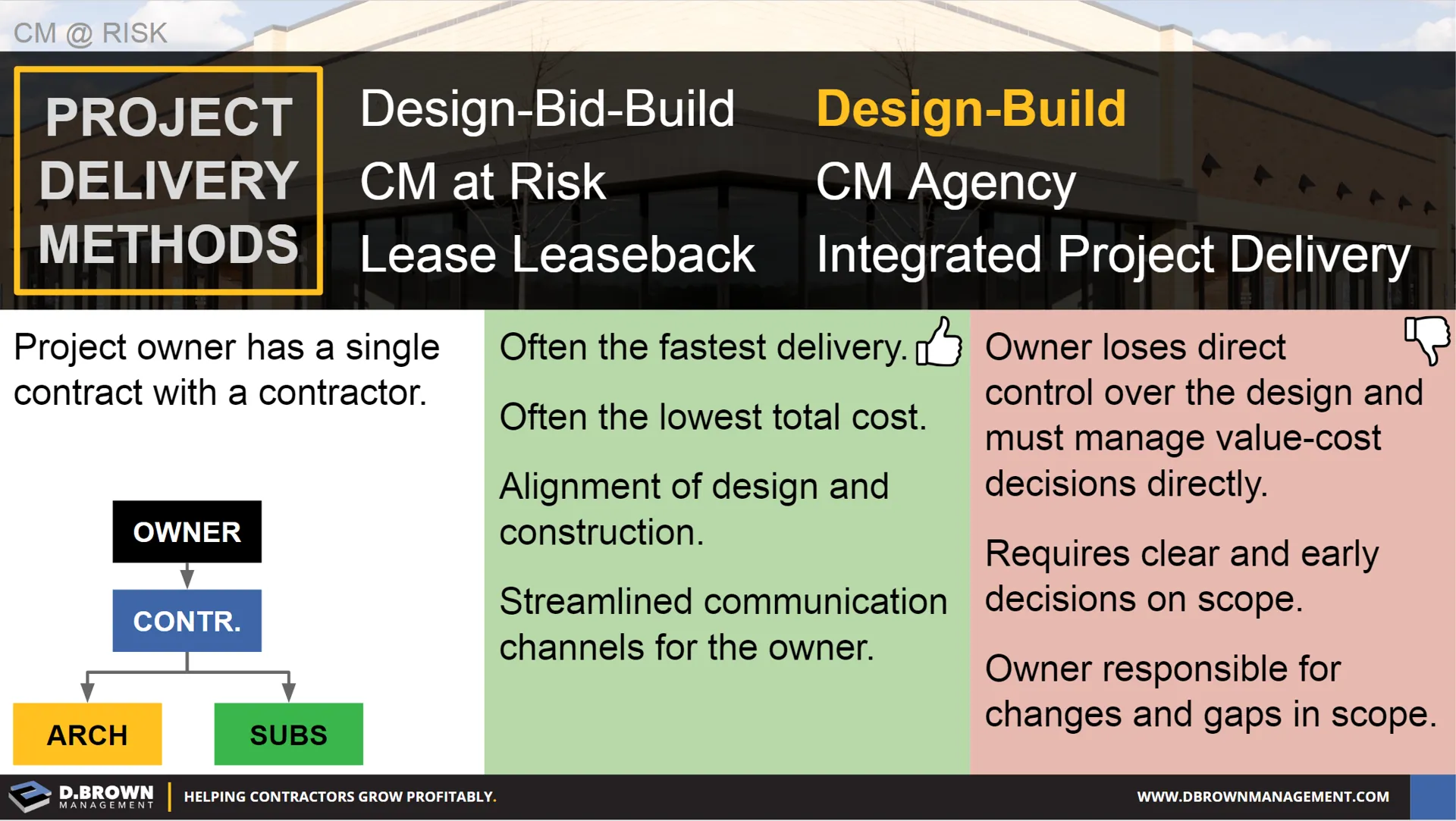
CM at Risk: Project Delivery Methods - Definition of Design-Build and pros and cons.

This integrates construction and design by putting the contractor fully in charge of the process which shortens delivery timelines and substantially cuts change orders.  

A study by Penn State and the Construction Industry Institute (CII) in 1997 showed many of the advantages of the Design-Build method, which are summarized in these slides from the Design-Build Institute of America (DBIA).

The key downsides of Design-Build include:

  • The project owner loses direct control over the design and must directly manage value vs. cost decisions.

  • The project owner must have clear and complete decisions on the scope of the project very early on.  

  • The project owner is responsible for changes and gaps in the scope. Deeply understanding the architectural design process and knowing how to manage it is a critical skill for any contractor delivering preconstruction services.  

Project Delivery - Design-Build
The preferred project delivery method. There is a reason 100 of ENR's Top 400 General Contractors use CMAR as the project delivery method for over 75% of their work. Leverage CMAR as part of your growth strategy....

Project Delivery - Design-Build
The preferred project delivery method. There is a reason 100 of ENR's Top 400 General Contractors use CMAR as the project delivery method for over 75% of their work. Leverage CMAR as part of your growth strategy....

The Four Traits of Successful Executives
There is a lot more to success than being charismatic and extroverted with a perfect track record. The ghSMART company conducted research on over 2,000 leaders, correlating detailed notes from the candidate screening process with their results as leaders.
Lean Principle - Observation (Gemba Walks and Learning to See)
One of the most important tools for improving productivity is going to the jobsite or work area and observing for an extended period of time with the intent to understand but not to immediately interact. Observation progresses through about 7 stages.
Aligning Career and Company Trajectories
Alignment of the people and job roles within a contracting business is what creates the synergies (1+1=3). Alignment of career and business trajectories is what makes both sustainable.