
Looking back over the last 30 years or more, no one can deny the dramatic changes in technology used within the construction industry. Steve Jost describes technology in the construction industry ranging from ready-mix concrete to pneumatic nailing guns to virtual construction and artificial intelligence.
During that same time, overall US construction industry productivity has been falling for decades. There are a few studies that show narrower bands of productivity increases in certain parts of the industry within shorter timelines.
There are many factors that play into these productivity numbers, so we aren't trying to lay out a simple cause-and-effect relationship.
Dimensions of Improvement
The intent of this article is to help anyone who is selecting a technology ensuring that they see improvements to one or more of the dimensions they are trying to improve, including:
Safety - which the construction industry has definitely seen improve over the last 30 years.
Quality of the finished product as measured by everything from fit-and-finish to longevity.
Productivity measured quite simply by less inputs for the outputs. Inputs to construction include labor, energy, and raw materials.
Schedule as measured by time from greenlighting the concept through design, construction, and use of the facility or infrastructure.
Scalability as measured by how much more work can be put in place next year than this year. Extremely critical as we are having construction employment growth significantly outpace US population growth driven by a few sectors like data centers.
Morale as measured by whether the people doing the work are satisfied leading to higher rates of both recruitment and retention. This is a critical dimension because of the ongoing decline in highly experienced people in our industry.
The K-Shape of Acceleration and Detraction
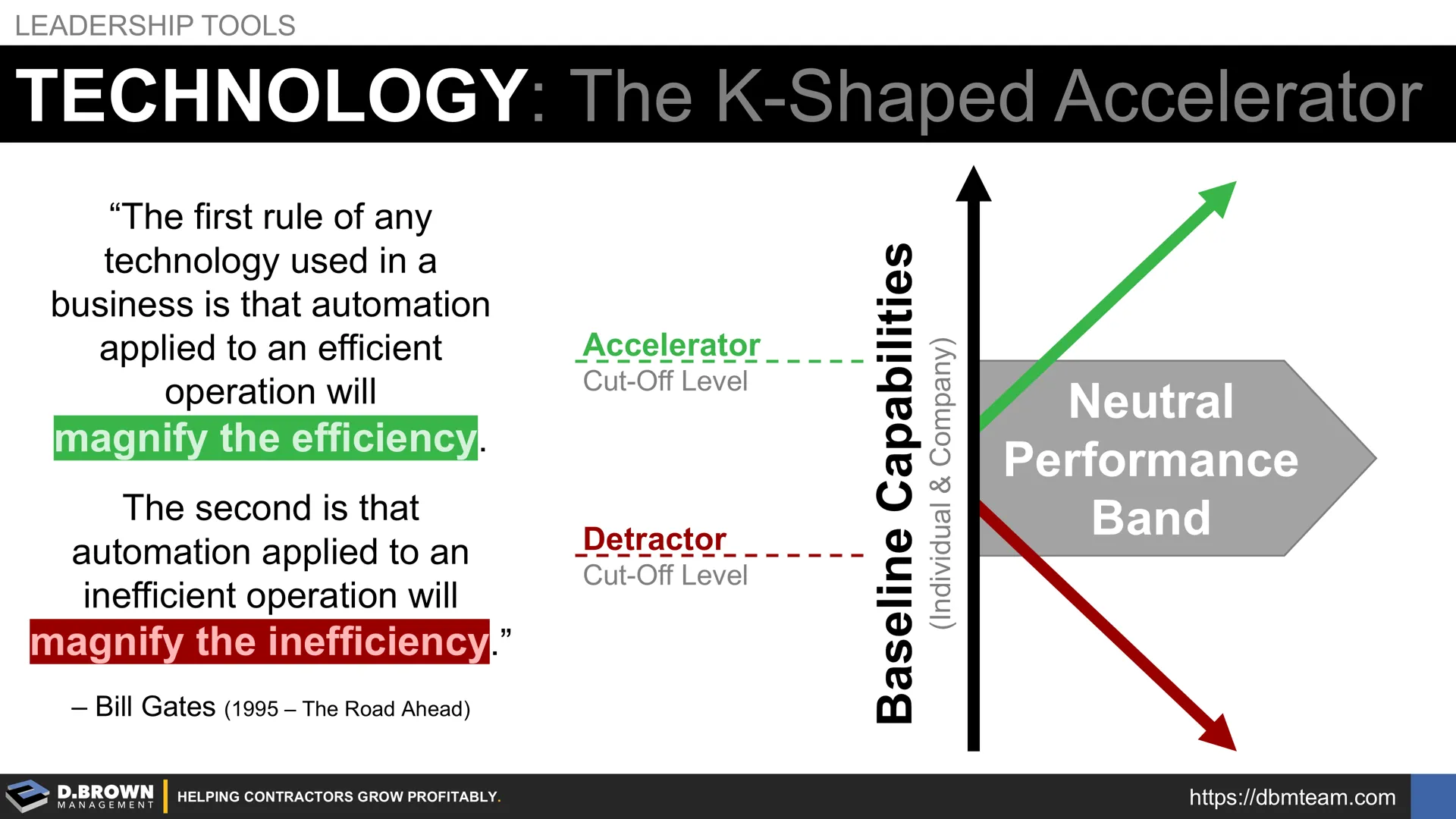
On any of these dimensions, there is a K-Shaped accelerator for any given technology when looking at the full bell-curve of people using the technology.
We heard "K-Shape" a lot when it came to economic impacts and recovery from COVID. It simply means that from the same event, two different groups will be impacted in different directions. For some, it will be an accelerator and for others it will be a detractor.
As an example, let's apply that same thing to a construction technology layout. From tape measures, chalk lines, and plumb bobs to scanning, BIM models, and robotic total stations (RTS).
Layout was always a task on a jobsite requiring a higher level of competency. Get it wrong and equipment doesn't fit, stub-ups don't hit walls, and a myriad of other challenges.
With the newer layout technologies, there is an incredible gain in productivity, schedule, and scalability when the whole system works.
When the whole system works is the big qualifier - and that is what is what drives the K-Shaped Acceleration for some contractors and even for some teams within those contractors. Let's look at some of the differences:
Older sets of layout tools could fit in a tool bag and, for a couple hundred dollars or less, provide a very comprehensive collection of levels, squares, and measuring systems. Today, a comparable set of layout tools can cost $100,000 or more when you include the computer, software, and total station.
An old set of layout tools would last for decades when cared for. The consumable cost was small. Replacement was usually only required when something was lost or damaged by being dropped. New layout tools require annual software licensing, are more easily damaged, and have shorter overall lifespans.
Though only a few people on the jobsite were great at taking a 2D set of plans and turning that into layout in the physical world, nearly everyone working on the jobsite could understand the basics of the tools. A far smaller group of people have a general understanding of how to use all tools required for the layout to work.
Fewer people were involved in the system from a set of engineered drawings to field layout. The people doing the layout in the field typically had a broader context of the whole project and building system. Using these tools requires more specialized roles so there are more people involved with narrower scopes. This means more system complexity with hand-offs between roles and less context for spotting problems if something is wrong.
Don't read this as a vote to go back to measuring sticks for everything. It is important to understand the differences in order to understand whether this is an accelerator or detractor for your situation.
The Capabilities and Conditions Axis
The vertical axis of the K-Shape represents the full bell curve of capabilities and conditions among the people using the technology, including:
Do you have enough layout work on a given project and across the company to make the technology investment worthwhile, even assuming you can get the entire system working correctly? If you have 100,000 points or more to lay out per year, and your project schedules allow at least a few hundred points to be laid out at a time, the investment is likely worth it. What are the equivalent numbers for the technology you are considering? Vendor invoices processed per month? Cubic yards of dirt moved? The number of 1.5-inch or larger conduit bends required each week? If your total throughput is not high enough, many technologies simply do not pencil out. They end up in the bottom half of the K-shaped curve.
Do the broader conditions beyond your control allow you to use the technology effectively enough to be an accelerator? For example, with BIM, if the architect, engineers, and other contractors aren't all working together on a model, including their field installation, then it makes it difficult to get the gains in productivity you were hoping for. This can be applied to any other technology from project management software to payment systems.
Do you have the right capabilities on your team, including those who design the overall workflow and manage the process through quality control, troubleshooting, and continuous improvement? This requires much more than having someone who is "good with computers." It requires every part of the system to work together, with validation at each step. A single mistake early in the workflow can result in thousands of points being laid out incorrectly, with installation following behind and the error not discovered until a physical conflict occurs. Rework must be factored into the measurement of overall productivity. It is not about how quickly the building was scanned, how many hours were spent on the model, or the efficiency of point layout. It is about the average total production output across all crews, not just your best crews.
Does your team have the desire to adopt this new technology broadly? If only a few people use it, you end up with a K-shaped accelerator for those individuals while the cost of the technology becomes a drag on everyone else. We see this frequently with accounting, project management, and estimating software. A few "power users" take advantage of most of the functionality and significantly improve their productivity. Others use only part of the functionality, gaining enough efficiency to offset the cost of the technology but not enough to create meaningful improvement. This is the "Neutral Performance Band," where dollars are simply shifted from labor to a software company. That can still make sense if labor costs are rising faster than software costs. Below this band are people whose productivity is negatively impacted because they are doing the work twice: once in their old system and again through data entry into the new system. Managers often cannot see this waste through software usage reports because the software is being used. They only see it when they observe the work itself and realize the new technology represents the second or third time the foreman has created the same material list.
It is important to realize that these factors change over time. For example, we had a contractor that had great project management systems. Nearly all their PMs fell into the top-half of the K-Shape. The management system including software, meetings, reports, and hierarchy of management worked very well. Their project outcomes were great as measured by all factors. It was a complicated system but one that everyone understood.
This went on for more than a decade of steady growth, profitability, and cash flow.
So, what's the problem?
Two things happened concurrently over five years. One, the great people on this highly experienced team who had been with the company for decades started to retire. Secondly, the construction market in their area started growing at a faster pace as happens with the ebbs and flows in all geographies and industry sectors.
That drove two other major changes. One is that we ended up with a lot less experience on the team. A PM that had been there for 25 years was retiring and the new PM only had a year or two experience with the company and their systems. The second was that due to increasing size of the team and average project size, the project team went from a PM and Foreman being responsible for a project to multiple more specialized roles including project accountant, purchasing, detailing, and manufacturing. The complex system that worked for a 2-3 person project team wasn't working for this scale.
The same system (technology) that was an accelerator a few years prior became a detractor because the capabilities and conditions changed.
Why Do Leaders Often Choose and Design Bad Systems?
Leaders making the decisions on a technology are higher up the vertical axis on capabilities and desire. They are the innovators and early adopters with the ability to make things work for them as accelerators. What is often missed is that there are probably 80% of the people who need to use the technology who won't be in that boat.
Most will dramatically underestimate the resources required to lead change. Saying yes to buying a new piece of equipment or software is easy. Getting everyone using it effectively to improve outcomes is hard.
Most will dramatically underestimate the combination of aptitude, desire, and time required for the majority of the team to develop the capabilities to use the technology as an accelerator. While it is uncomfortable to talk about, we all have very different aptitudes. For any given technology, there are many people who will never develop the capabilities for it to be an accelerator.
Most will analyze the return of making a sub-system more efficient rather than the whole business more effective. This can be looked at from the job role level to the overall business model. Some changes in technology are very localized and just part of continuous improvement. Some are absolutely the right change at the right time. More often than not, a change in technology is a distraction from much bigger opportunities.
Hopefully this gives you some additional ideas on how to look at the range of technologies you use in your company. Make sure you are creating real value, not transactional value, and hopefully not destroying value.