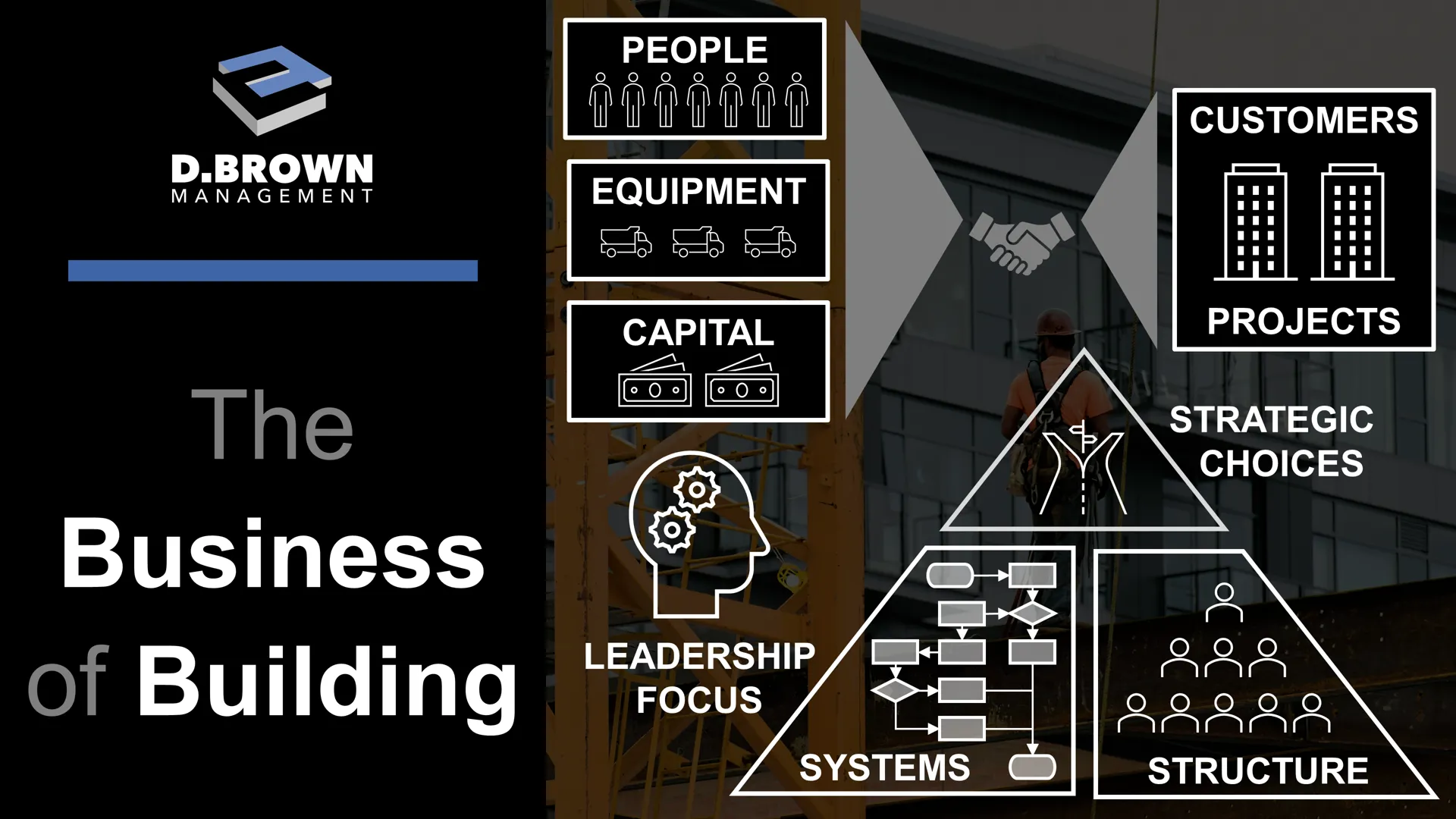
The Business of Building Series

Building projects requires technical expertise and resources. Building a construction business is about developing and aligning those capabilities with customers. Growth and time require different leadership focus, strategies, systems, and structure.

D. Brown Management Profile Picture
Share


Article Image


YouTube  |  Spotify  |  Apple  |  Audible 


This is a series of training, discussions, and resources that apply to contractors at all stages of growth. These include the what, how, and why levels of training and resources. We will cover most aspects of growing a contractor's business. The discussions include real-world examples of application and outcomes, both good and bad. 


  1. Stages of Construction Contractor Growth (Intro)
  2. The Construction Contractor Business Model (Intro)
  3. The Talent Value Stream (TVS)
  4. Job Role Transitions (Intro)
  5. Prioritization Basics
  6. Job Role Description Basics
  7. Strategic Decisions at all Levels
  8. Scoreboards and Scorecards (Intro)
  9. Building Strength-Based Teams (Intro)
  10. Management Systems (10 Principles)


The Business of Building Series
Building projects requires technical expertise and resources. Building a construction business is about developing and aligning those capabilities with customers. A series of discussions about all elements of a construction business at all stages of growth, including real-world examples of application and outcomes both good and bad....

Related Training
The Business of Building Series
Building projects requires technical expertise and resources. Building a construction business is about developing and aligning those capabilities with customers. A series of discussions about all elements of a construction business at all stages of growth, including real-world examples of application and outcomes both good and bad....

The Knowledge Management Pyramid (DIKW)
Knowledge Management is a complex topic and the contractors who learn to manage it the best will have an edge in the market. There are several models that can help you visualize the differences between different types of “knowledge” in your organization.
Definition - Deliberate Practice
Practicing with a clear awareness of the specific components of a skill we are working to improve, and exactly how to improve them. It is not simply doing something repetitively for enjoyment or until it becomes mindless.
Balancing Modes of Prioritization and Career Progression
If your workload prioritization seems impossible, try looking at it from a higher-level of prioritization. We all must prioritize in life and at work. Our outcomes are heavily impacted by how effective we are at prioritization.