
We Fly a Lot...
Contractors that have large geographical footprints fly a lot.
The lessons below are something everyone can relate to, especially those who fly Southwest and have seen the changes over time as they moved from a scrappy startup to the 4th largest US airline.
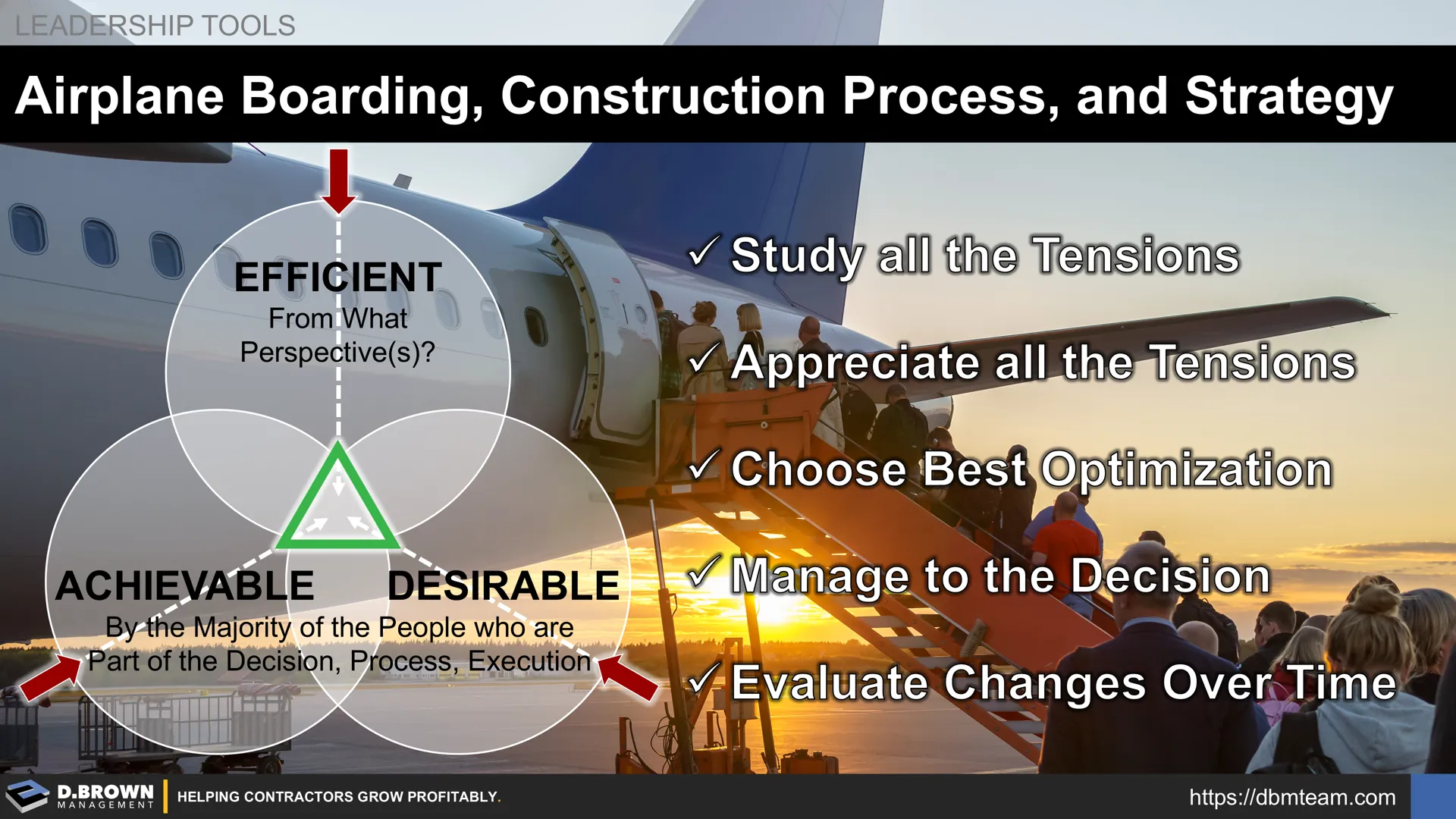
From a leadership standpoint, we are going to look at the tensions that exist between what is efficient, achievable, and desirable; and how those change over time. We are going to unpack a few things in this article:
Oligopolies and Monopolies: Market share and margins - economic theory and practice.
From New Entrant to Key Player in a Market: Similar to Southwest, how a smaller contractor can leverage a strength to compete against the larger incumbent players.
The Psychology of Strategy and Execution: Aligning what people say they want, what they demonstrate they want based on behavior, and what is needed. Construction contracting requires engineering of both materials and people.
Navigating Growth: What changes as the scrappy startup becomes one of the largest in the market? What changes about market strategy, organizational structure, management systems, and leadership focus?
Management and Continuous Improvement: Once a decision is made, there are thousands of details that must continually be adjusted to make things work. This is not a problem with the decision; it is a requirement of the team's culture and capabilities. Leading change is no small challenge.
Besides those five things, nothing major in this article. :)
We are not going to re-cover everything we've covered in other insights. The links in the bullet points above will give you a good foundation for the comparisons covered next. Use these points including supporting articles to look at your business and career, including:
Where you have been
Where you are at
Where you are heading
The Startup Strategy
Though Roger Martin's five interlinked questions do define strategic choices weren't codified when Southwest started, the principles remain the same.
They defined their "playing field" as point-to-point flights people commonly traveled between, starting with Dallas, Houston, and San Antonio. Distance between each point were 190-250 miles with flight time 40-50 minutes.
Their competition for these routes was taking the bus or driving. This choice also kept Southwest off the radar of the larger incumbent airlines who defined these routes as unprofitable.
Winning and keeping customers was a combination of speed and price. Comfort simply had to be comparable with the bus or driving. Study the Kano Model (5 min video) of customer satisfaction including how delighters become standard expectations over time. This is very similar to the choices a contractor makes when starting up.
That combination of speed and price with baseline comfort defined the capabilities that Southwest required to win; and the management systems that were required to develop, scale, and sustain those capabilities.
This is a great example of how you see strategic decision making playing out. As you will see, with growth and changes to market conditions, those decisions must be revisited.
The Business Model
Strategy is a lot more than inspiring ideas. There's a lot of work that goes into ensuring the strategy is even viable, and that it is truly a better choice than other options available to you. That's where business and financial modeling comes in. Profitability and cash flow are not primary objectives, but they are both necessary to reach your objectives.
Like all businesses, Southwest required a business / financial model that was sustainable and scalable. This includes generating enough profitability and free cash flow to sustain growth. No business can sustain poor cash flow and profitability for long - even those backed by incredible amounts of venture capital. Southwest was growing capacity and revenue at a compounded annual growth rate (CAGR) of about 25% per year for the first 15 years. Closer to 40% in the first five years.
Airlines are very capital-intensive businesses and there are a few things relatively fixed for every airline including cost of the planes, cost of fuel, and speed of the actual flight. For an airline, about 40% of their operating costs are the same as every other airline.
Think about a civil contractor - while different contractors may get different "deals" on equipment, those differences aren't significant. Everyone is paying roughly the same amount for a machine, the fuel, and then has capacity for a certain amount of production (cubic yards per - or some other metric).
Southwest had to choose the areas of their operation where they could materially increase speed and lower costs. There are thousands of details that contribute but like the 80/20 rule, the majority of the impact will come down to a handful of priorities. It is the role of leadership to define these priorities and continually keep pressure on them.
A big one of those for Southwest was shortening turnaround times including passenger loading, maintenance, and restocking.
Saving 10 minutes turnaround on the short flights (190-250 miles) and flight times (40-50 minutes) had a two-fold impact.
From a customer standpoint, saving 10 minutes feels huge on a 40-minute flight from San Antonio to Houston. Relatively speaking, that's 25% of the flight time. That same 10 minutes is inconsequential on the 10.5 hour flight from Los Angeles to London. From a passenger perspective, it's only a 1% of the flight time. They are jet lagged and tired anyway. Completely different dynamic.
From a business standpoint, on those short flights, shortening the turnaround time by 10 minutes allowed an extra flight or two per aircraft and crew day. The variable cost for that extra flight would come down to fuel, peanuts, and a few other costs - relatively minor.
As an example, if you are able to get 9 flights instead of 8 flights out of the same crew, airplane, and terminal then you have 12.5% additional revenue. At a normal 5% pre-tax operating income and with 40% of non-labor operating costs being per-flight, your costs only go up about 4.75% (40% x 95% x 12.5%). That moves your pre-tax operating income to 7.75% (55% increase).
Compared to a long-haul flight, that same operational lever doesn't work. You get one flight from Los Angeles to Heathrow in that shift; regardless of turnaround times.
We see this business dynamic play out regularly with contractors. This is what makes the difference between a contractor performing to industry benchmarks, those that are performing below those benchmarks, and those that are 2-3X those benchmarks which is what we target with our clients.
What are the similar levers in your business?
Is it utilization of expensive equipment for a civil contractor?
Utilization of PM and Superintendet resources for a general contractor?
Time-on-Tools (ToT) for craft-labor intensive businesses?
How do you measure utilization? It's a lot more than being busy.
Consider that Southwest's model evolved over time. Today, their average flight length is 3X longer than it was when they started. That average still includes those 40-minute routes along with some 6.5 hour routes (about 10X longer). Those minutes saved in turnaround times matter a whole lot less on those longer routes so there are different levers they need to pull today. This is no different than how a contractor's business changes.
How have those levers changes as your business has changed?
How are those levers different for different types of projects, sizes, schedules, and delivery methods?
The People Aspect
People Part 1: Capabilities Must Be Aligned
This is where models meet the real world.
If turnaround times were so important to Southwest as illustrated above, why didn't they use the fastest possible method?
The "Steffen Boarding Method" is modeled to be 20-30% faster than the unassigned seats + random boarding order that Southwest used. This is something important when it comes to design of standards and systems. Typically, the people who are promoted into positions to design systems have a combination of traits that got them into that higher-level role. This combination of traits is simply rarer in the population. There is nearly always a tendency to design systems and tools that are too complex to be utilized effectively by the full range of people that need to use them. Most of the time, this is not intentional - they are humble and trying to build good systems to help others. They are just at a level of competence defined as "Unconscious Competence" so they don't realize how much they actually do out of habit.
Jason Steffen was an astrophysicist so likely fell into this category. As a side note, he was working on methods for detecting new planets at the time he laid out this system for boarding planes prompted by waiting in a long line.
The method only required a few things to work perfectly:
Assigned seats (doable)
Assigned boarding order by passenger - just 100-175 people lining up in perfect order every time.
Families traveling together having to choose to either sit apart or board apart.
...and that is why no airline has ever tried this method.
The other method that Southwest did try and has been shown to reduce any other method by 30-40% was two-door parallel boarding. Load the plane from the front and rear doors. There were some select experiments run with this method in the 2000s and 2010s. In this case, the added complexity was less on the passenger side and more about the gate design at the terminals. For some airports at the time like Burbank had great conditions. They were loading from the ramp rather than through a jetway bridge, and they have good weather year-round. You wouldn't be doing this at MSP (Minneapolis-Saint Paul International) during December.
The cost and added complexity of the dual jetway bridges wouldn't pencil out by the time the experiment was being run since the average flight was now 2X longer than the original 250-mile average. Additionally, during this time, Southwest was growing from 30,000 to 60,000 employees. Consistency of operational standards at this scale is a lot more important.
People Part 2: Possible Capabilities and Actual Capabilities are Usually Different
When tests are done comparing boarding methods and times, it is important to note that real-world average boarding times were 10-25% slower than the same method in a test scenario. No matter how realistic the test scenario is made out to be, it is not fully mimicking real-world conditions and variability. Wheelchairs, families, people rushing the gate out of order, connecting flights arriving late, fatigued travelers, alcohol, etc.
With that said, the ranking of the boarding methods for speed isn't changing with the real-world conditions; they are all 10-25% slower.
This is similar for contractors. There can be modeled estimates that aren't possible to achieve even in the best conditions. We often run field tests and there is nearly always a 2X difference between the fastest 25% of the workforce and the slower 25% of the workforce. Real-world conditions slow both the fastest quartile and slowest quartile down while widening the gap.
For self-perform contractors, this is why it is incredibly important to:
Control every element of the environment possible before the craftspeople even move into an area.
Use historical production feedback to refine estimating units and factors applied to different conditions including workforce experience.
People Part 3: Desirability and Satisfaction May Not Be Tied to Efficiency
If Southwest had the best boarding times, why do all major airlines choose a method that is 36% slower?
And why did Southwest change to this method in 2026?
This is one of the challenging dichotomies of leadership and systems design. You have to listen to what people say and observe what they actually do. Both are important and often they are not connected. Leadership including effective design of services, products, and systems has as much to do with psychology as it does with engineering. In many cases, the feelings play a far larger role than objective facts.
For example, Southwest's method of boarding is essentially "Herding Cats" (funny 2000 Superbowl ad) has proven to be the fastest - yet always gets the lowest scores.
People like to feel special so that is why tiered boarding groups based on status groups are the norm.
If you are one of those people who objectively looks at things through an efficiency lens - your calculation of time isn't incorrect. Your understanding of the full bell-curve of personality traits needs some work. Think about this as it applies to every aspect of your project and company.
People Part 4: Engagement Matters for Execution
Remember the IKEA Effect - people appreciate involvement in the discussion, decision-making process, and design of the solutions. There are lots of tools and techniques to involve a team. It is beyond the scope of this article but give us a call. We will freely share any lessons we've learned (good and bad) about how to engage a team while still getting to critical decisions that don't end up being the equivalent of beige paint. The video below gives one example we call "PICK SMART" that combines several methods helping develop, evaluate, and align teams.
QUICK SELF-REFLECTION
Truthfully, how many people reading this article have seen a problem, gone to their office, created a system, tool, spreadsheet, etc. that seemed perfect only to have it fall short of expectations when rolled out? If you have never had that experience, please contact us. We want to buy you a great dinner and learn your secrets. :)
People Part 5: Wisdom About Engagement from Two CEOs
There are two pieces of wisdom related to systems, scale, and leadership that fit well here:
Great examples of crystalized intelligence and the wisdom at the top of the knowledge management pyramid.
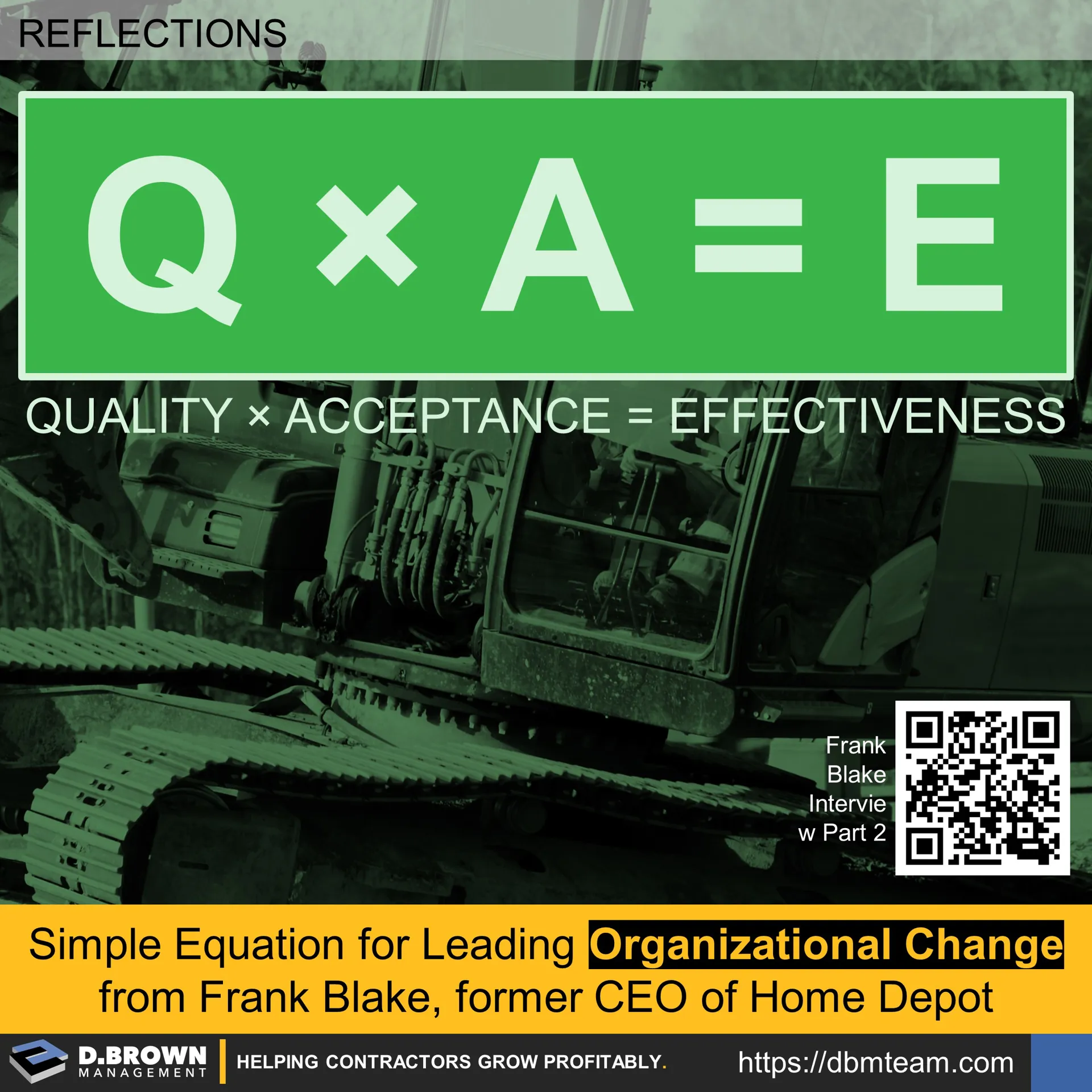
Frank Blake who is a retired CEO of Home Depot described a formula (Q x A = E). The organizational effectiveness of an idea is product of the quality of the idea and the acceptance of it throughout the organization. (5-minute video excerpt starting at 8:00)
Indra Nooyi who is a retired CEO of PepsiCo uses the term "Micro-Understanding" describing her leadership philosophy as "Zooming in before zooming out" - visiting factories, walking manufacturing lines, talking to R&D, talking with customers, observing customers, etc. Her perspective is that leaders who don't deeply understand the business at the ground level will make decisions at the top that can't be implemented. She is very clear that this is not the same as "Micro-Management" though many people conflate the two leading to a lot of ineffective behaviors. (8-minute video excerpt starting at 14:16)
Growth - Scale and Trajectory
Like profitability and cash flow, growth by itself is not a primary objective though it may be necessary to execute your strategy and achieve your vision. For example, Southwest passenger miles per employee metric is over 2.5X higher today than it was in 1975. For certain aspects of a business, there are economies of scale. Growth should always be for the right reasons - bad growth never works out in the long run.
There are two things to think about when it comes to growth.
First is the absolute scale. 500 employees like Southwest had around 1975 spread across three cities that were less than an hour apart is dramatically different than the 70K employees Southwest had in 2025 spread across 120+ cities up to 6.5 hours apart. Using the rule-of-thumb that an organization must re-examine leadership focus, strategy, structure, and systems at about every 3X in headcount, Southwest would be on about their 5th major change since 1975.
READ MORE (BOOK): The Social Brain - The Psychology of Successful Groups
The second thing to think about is trajectory - how fast the business is growing. You could say that this is five major changes just based on organizational size over 50 years, so once per decade. Not bad. Here's what it actually looked like in their growth:
From startup and their first flight in 1971 through 1975, they grew to 600 employees. That's about the first five stages of growth just in those first 5-7 years.
Tripled again by 1980 and again by 1985 to over 5,000 employees. About 25% compounded annual growth rate (CAGR) for headcount - faster growth rate for added capacity which has to do with economies of scale.
Growth then slowed down to 15% CAGR, so the next tripling of size took 10 years ending 1995 with about 20K employees.
Growth then slowed down to 5% CAGR, so the next tripling of size took 20 years ending 2015 with about 50K employees.
Growth in the last decade has slowed to 3.5% CAGR through 2025.
Both high and low trajectory growth have incredible leadership challenges - they are just very different challenges:
At 15% or more per year has incredible leadership challenges attracting and integrating people while adding a layer of management every 3-5 years including other associated changes to the structure, systems, and strategy.
At slower growth, one of the biggest challenges is retention of people as they won't have an open path for career growth. This hits those with higher trajectory career growth potential hardest.
Culture Changes and Continuous Improvement
Culture is defined by the behavioral norms of the group. It is shaped by the examples and hard boundaries set by leadership. This has to do with what is interpreted by the organization, not what is intended by those in leadership positions. Always remember the leadership spotlight.
All organizations and teams have a culture.
That culture may have just emerged from a collection of people or may have been intentionally shaped.
The important factors are whether it is aligned with where the team is heading and consistent across the team.
You could see Southwest's culture evolve over time if you have been flying with them long enough. There was a scrappiness they had as they were fighting from an underdog position with about 20% of the scale of the bigger players in 1995 (United, Delta, American). This is no different than a contractor building their reputation, capabilities, and capacity in a market.
At that time, their crews would practically push you onto the plane to meet a turnaround goal and especially a curfew like some airports have. It was always with a great sense of humor and urgency.
By 2025, they are now about 60% the scale of United, Delta, and American. Even though their piece of the pie is substantially larger, their growth had slowed down a lot. Delays were more frequent - not because of anything their people were doing, but because of the complexity and length of their routes. You could see that have an impact because it was beyond the control of the local teams. That happens when contractors grow too - or good teams are placed on a tough / slow project.
The deeper cultural elements of being polite, caring, and problem solving were still there.
You could see that during the change to tiered status group boarding with assigned seating. That was a huge change to roll-out across 70,000 people. Since we fly multiple times per week, we got a front-row (or close to it) seat observing these changes. It was neat to see little tweaks made every week that continually made the system work better.
About six weeks into the change, one flight attendant was ensuring there was bin space in the first 7 or 8 rows which helps improve boarding time. That was a change that was noticed across all flights that week, so it was a process change from the week before. When asked about the change, her eyes lit up and she explained they had a message board and were sharing lessons-learned each flight then making improvements. She rattled off a few other changes they had recently made.
That is the culture, continuous improvement, and management that it takes to move a strategic decision into routine execution.
A bad culture starts questioning the decision as the first problems come up.
A really bad culture starts badmouthing the decision before it is even tried to each other.
An even worse culture complains with the customers during the transition.
How well do you and your team do at turning decisions into consistent delivery?
Evolving Definitions of "Efficient"
Southwest chose what was efficient in the 1970s and that was turnaround time with very short point-to-point routes.
By the late 1990s they were testing some longer routes and connecting flights. This was made into an intentional growth focus in the 2010s as most of the point-to-point routes were already taken. The legacy focus on turnaround times was less valuable during this stage of growth.
The market expectations and business dynamics changed by 2025 and the formal change to the boarding method was made in Q1 of 2026. The definition of "Efficient" moved from minutes saved in turnarounds to differentiation of customers including the ability to "Buy Up" for seating and adding baggage fees.
The actual demonstrated behavior showed what customers valued:
No major changes in passenger miles (though it is still early in the change)
Availability for paid upgrades to seating and boarding were significantly increased with the change. Southwest created their own version of a "Premium Tier" that rewards their A-List customers but allows a lot more capacity for passengers to upgrade. Paid upgrades increased from 20% in 2025 to 60% in Q1 of 2026. Those paid upgrades are expected to be worth $1.5B annually.
Baggage fee income is expected to grow nearly 3X to $1B in 2026. That growth is without any additional costs.
It is early in the decision and execution process so a lot can happen. Overall customer satisfaction scores have fallen slightly in 2026. That could be due to the inevitable turmoil of the changes. Passenger miles haven't dropped off so that is a behavioral as compared to a stated action. If the paid upgrades and baggage fee trend continues, that will add $2B+ to revenue with little increase in operating costs.
These dynamics are no different for contractors:
What are you doing that is legacy and may not be serving you and/or your customers well today?
What aren't you doing that wasn't required in the past but may be desired by your customers and/or employees today?
Are your customers paying a premium for the things they say they want? Stated vs. demonstrated behaviors.
Would your customers truly leave if you changed some processes, reduced some services, and/or increased some pricing?