The Basic Math of Prioritization

Discipline yourself and your team to probabilistic thinking.

D. Brown Management Profile Picture
Share

Build your project, career, and business more profitably by continually allocating more of your resources to their "Highest & Best" use, focusing on prioritized probabilities rather than possibilities.  
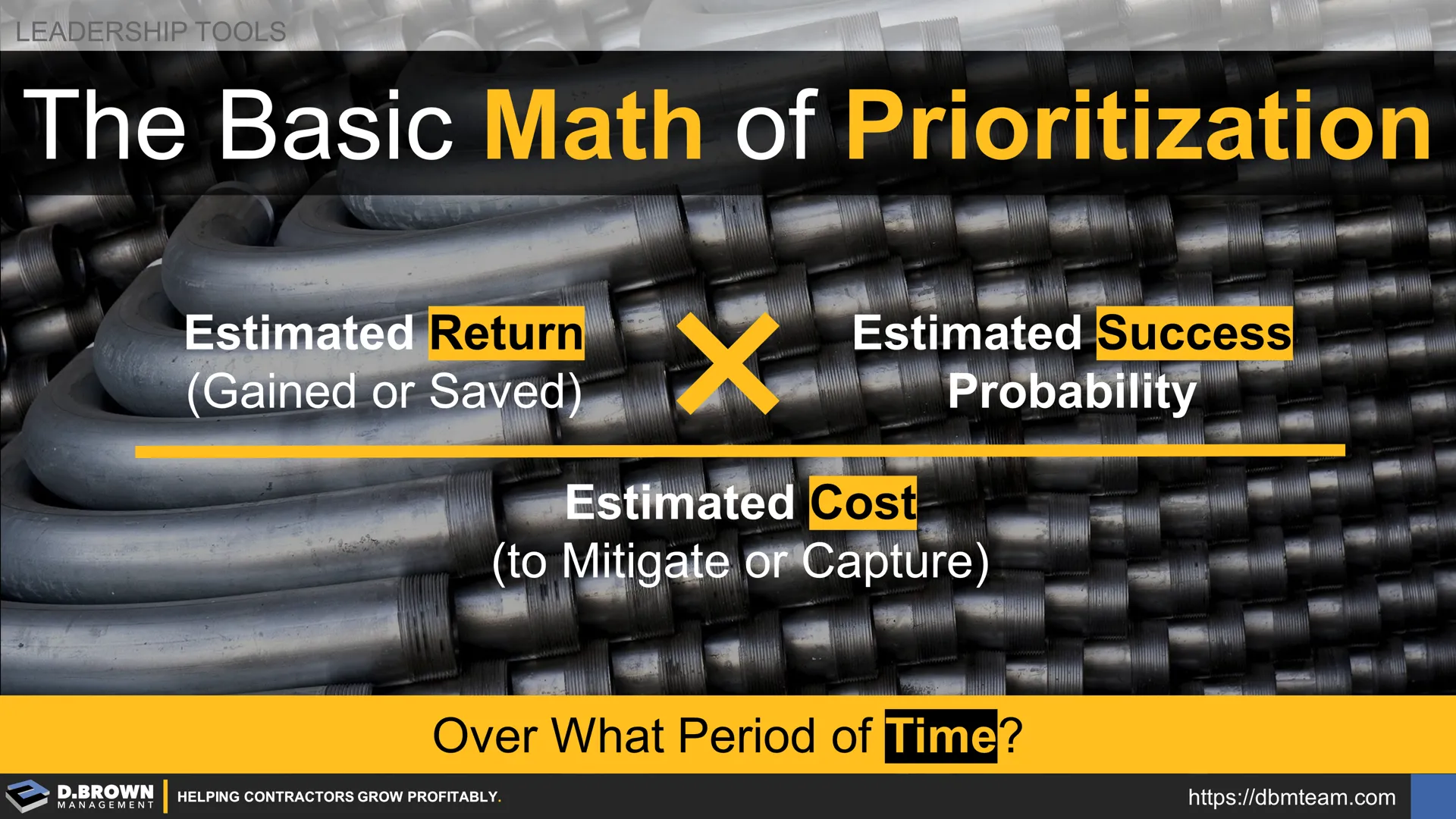
Leadership Tools: The Baisc Math of Prioritization.

Set a big vision for what you ultimately want to accomplish. There is nothing more wasteful than effectively prioritizing how to reach the wrong goal.  


Get the right people in the room to stretch each other. The right people and purpose sets the foundation for everything that will be achieved.  

Develop a full range of possibilities with active brainstorming sessions. For teams, utilize the 5D Facilitation process. For high-leverage decisions, bring in outside expertise to stretch thinking.  

Once you have developed the range of possibilities, force the discussions into prioritization and sequencing by using tools like PICK Charts and SMART Goals.  


Remember that there are other factors to prioritize beyond financial when it comes to building true wealth in life.   

Thinking in Bets:  Making Smarter Decisions When You Don't Have All the Facts by Annie Duke


Related Training

Different Stages of Market Growth and the Types of People Required
Every contractor will experience different stages of growth as a company and within the markets they are competing in. Understanding the different types of people required at each stage will help the contractor navigate them smoother.
Our Principles for Creating Value in Careers, Projects, and Contracting
“As to methods, there may be a million and then some, but principles are few. The person who grasps principles can successfully select their own methods. The person who tries methods, ignoring principles, is sure to have trouble.” - Harrington Emmerson
Contractor Business Model: Evolution with Stages of Growth
As a contractor navigates the different stages of growth, the complexity of their business model evolves, including their organizational structure, management systems, and people. Seeing this model visually helps identify bottlenecks and constraints.