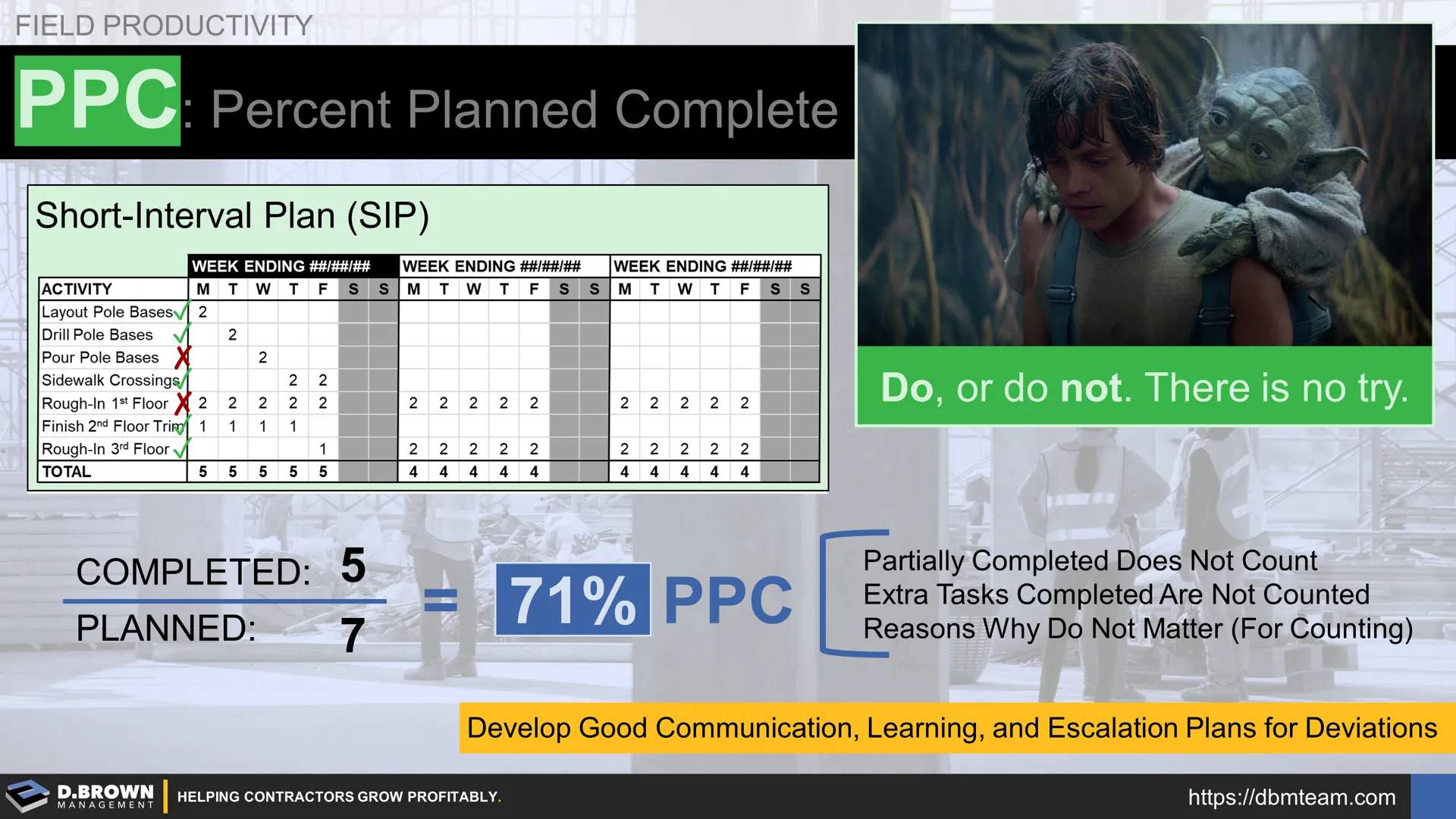
Percent Planned Complete (PPC) - Calculation Example

Yoda would be the perfect coach for managing schedules on projects: “Do or do not. There is no try.”

D. Brown Management Profile Picture
Share
Field Productivity: Percent Planned Complete (PPC). Do or do not. There is no try.

This is the heart of Percent Planned Complete (PPC) and the weekly cycle of continuous production improvement. Measurement of PPC is rigorous:

  • Partially complete tasks DO NOT count.
  • Extra tasks (not planned) DO NOT count.
  • Reasons why DO NOT matter except for the weekly learning aspect. 

Imagine designing a field supervisor coaching program with PPC at the center.  

For 12 weeks, an experienced coach would work hands-on with a Foreman starting with a review of their PPC from the prior week and then developing the next week’s Short-Interval-Plan (SIP), focusing on:  

This coaching will improve the Foreman’s capability to execute their key responsibilities and achieve their key results.  


Field Productivity Workshop


Percent Planned Complete (PPC) - Calculation Example
Field labor is the often the biggest variable on a construction project - making it the biggest risk and opportunity....

Related Training
Percent Planned Complete (PPC) - Calculation Example
Field labor is the often the biggest variable on a construction project - making it the biggest risk and opportunity....

Last Planner System (LPS) Overview: Should > Can > Will > Did > Improve
The Last Planner System (LPS) developed by the Lean Construction Institute (LCI) is the codification of the practices used by the best project teams. There are elements that EVERY contractor can use to improve performance of their projects and business.
Evolution of Project Delivery Methods
Project delivery methods for contractors will become increasingly more integrated from project owner through all key parts of the supply chain, which is a return to models used in the early 1900s with some modernization improvements.
Setting Standards and the Feedback Loop
Set the standard. Train to the standard. Certify to the standard. Plan the work to the standard. Execute to the plan and the standard. Check against the standard. Make prioritized improvements to the standard, training, planning, and execution.